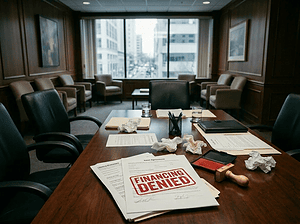
Mortgage financing falls through when a buyer’s lender withdraws or denies final loan approval after a purchase agreement is already signed, usually because of a low appraisal, a change in the buyer’s financial picture, or a gap between pre-qualification and full underwriting. In Massachusetts, what happens next depends almost entirely on whether the buyer properly exercised the financing contingency in the Purchase and Sale Agreement before its deadline.
Why does mortgage financing fall through before closing?
Mortgage financing falls through most often because the appraisal comes in below the agreed purchase price, the buyer’s financial situation changes between pre-approval and closing, or the buyer never had full underwriting approval to begin with. For the appraisal side of this problem, see what to do when the appraisal comes in low. For the full contract that governs how the contingency works, see the Massachusetts Purchase and Sale Agreement.
A low appraisal is the most common trigger. If the lender’s appraised value comes in under the contract price, the bank will not fund the full loan amount, and the buyer either has to bring extra cash to closing or renegotiate. Second, a buyer’s financial picture can shift in the 30 to 60 days between pre-approval and closing. A new car loan, a job change, a missed payment, or a dip in credit score can be enough for an underwriter to pull back an approval that looked solid weeks earlier. Third, many buyers carry only a pre-qualification, not a fully underwritten commitment. The gap between a pre-qualification letter and true underwritten approval is where a surprising number of Boston deals quietly die.
What Does the Financing Contingency in a Massachusetts P&S Actually Control?
A financing contingency is a clause in the Purchase and Sale Agreement that lets a buyer cancel the deal and recover their deposit if they cannot obtain a mortgage commitment by a specific date. In Massachusetts, this single clause determines almost everything about what happens to the deal, and to the deposit, when a buyer’s loan does not come through.
Massachusetts courts and standard P&S language treat these deadlines as time-of-the-essence. That legal phrase means the dates are not suggestions. A buyer who applied for financing on time but notifies you of the denial one day after the contingency deadline may have already lost the protection that clause was supposed to give them.
If the contingency was valid and properly exercised, the buyer is not in default. They used a protection they negotiated for, and Massachusetts practice typically has the deposit returned to them. The deal ends. It’s frustrating, but it’s clean, and it does not expose you to further dispute.
What Happens to the Deposit When Financing Falls Through?
The deposit’s fate depends on whether the buyer had a valid, timely financing contingency at the moment the deal collapsed. If the contingency was still active and properly invoked, the buyer generally gets the deposit back. If the contingency had already expired, been waived, or was never triggered correctly, most Massachusetts P&S agreements let the seller keep the deposit through a liquidated damages clause.
In Massachusetts, deposits typically arrive in two stages: a smaller good-faith deposit with the initial Offer to Purchase, and a larger deposit at P&S signing, often bringing the combined total to roughly 5% of the purchase price. On a $900,000 property in Roslindale, that is not a trivial sum sitting in an attorney’s escrow account.
Most standard Massachusetts P&S agreements include a liquidated damages clause: if the buyer defaults outside a valid contingency, the seller’s remedy is limited to keeping the deposit. You do not get to keep the deposit and separately sue for additional damages. If your P&S lacks a liquidated damages clause, other remedies may exist, but they depend heavily on exact contract language. Massachusetts is an attorney-closing state, and your closing attorney, not your listing agent, is the one who determines where you legally stand.
| Scenario | Contingency Status | Typical Deposit Outcome |
|---|---|---|
| Buyer applied on time, denied by deadline, notified in writing on time | Valid and properly exercised | Returned to buyer |
| Buyer’s loan commitment date passed with no written notice | Expired | Seller generally keeps deposit under liquidated damages |
| Buyer waived the financing contingency to strengthen their offer | Waived | Seller generally keeps deposit |
| Appraisal came in low, buyer cannot bridge the gap | Depends on appraisal contingency language | Varies; often negotiated separately |
How Should Sellers Respond in the First Week After a Deal Collapses?
- Contact your attorney before anyone else. Have them review the exact contingency dates and notification language before you make any assumptions about the deposit.
- Ask your agent to check backup offers. If your home received multiple offers, a strong second-place bidder may still be interested, sometimes at the original terms.
- Reassess your pricing strategy before relisting. A quick relist at the same price often works in tight-inventory neighborhoods, but if the market has shifted since your original listing, revisit your comparative market analysis.
- Understand the “back on market” stigma is smaller than sellers assume. Buyer financing failures are common enough that experienced buyers don’t treat a BOM listing as a red flag on its own.
- Review your disclosures again. If any material facts changed, or if you completed repairs during the previous under-agreement period, make sure your listing reflects the current condition accurately.
How to Reduce the Risk of Financing Falling Through Again
Reducing the odds of a second collapse starts with vetting the strength of your next buyer’s financing before you accept an offer. Ask your agent to request a fully underwritten pre-approval, not just a pre-qualification letter. Confirm the lender is local or has closed deals in Massachusetts recently. Watch the size of the buyer’s down payment relative to their loan amount. Don’t automatically accept the highest offer if the financing terms are weaker. A slightly lower offer with a stronger, fully underwritten commitment often closes more reliably than a higher offer with a thin contingency.
Frequently Asked Questions
Why does mortgage financing fall through most often in Boston?
Mortgage financing most often falls through in Boston due to a low appraisal, a change in the buyer’s financial situation between pre-approval and closing, or reliance on a soft pre-qualification instead of a fully underwritten loan commitment. Property-specific issues like outdated electrical systems can also cause certain loan types to be declined.
Do I get to keep the deposit if the buyer’s financing falls through?
Whether you keep the deposit depends on whether the buyer’s financing contingency was still valid and properly exercised. If the contingency expired or was never validly triggered, most Massachusetts Purchase and Sale Agreements let you keep the deposit under a liquidated damages clause; if the contingency was valid, the deposit typically returns to the buyer.
How long does a buyer have to notify me if their financing falls through?
Massachusetts treats financing contingency deadlines as time-of-the-essence, meaning the buyer must secure their loan commitment and notify you in writing by the exact dates written into the Purchase and Sale Agreement. Missing that deadline by even a day can forfeit the buyer’s contingency protection.
Can I sue a buyer for more than the deposit if their financing falls through?
Generally no, if your P&S includes a standard liquidated damages clause, since that clause limits your remedy to keeping the deposit rather than allowing additional legal claims. If your contract lacks that clause, other remedies may be available, but they require an attorney’s review of the specific language.
How quickly can I relist my Boston home after a financing collapse?
You can typically relist as soon as your attorney confirms the deposit dispute is resolved or non-existent, which often takes just a few days. Boston’s tight-inventory neighborhoods, including Jamaica Plain and Roslindale, tend to absorb relisted, well-priced homes reasonably quickly, though timelines vary by season and property type.
Should I accept a backup offer instead of relisting from scratch?
A strong backup offer can save time if you had multiple interested buyers on your original listing, since that buyer may already be familiar with your property and comfortable with the terms. Whether it’s the better move depends on how strong that buyer’s financing looks compared to relisting and seeking a fresh pool of offers.
Have questions? Let’s connect.
About Juan Murray
Juan Murray is a Boston broker associate with more than 30 years of experience helping buyers, sellers, and investors across Greater Boston, personally leading every transaction from the first conversation through closing.
RE/MAX Real Estate Center · (617) 721-0961
Equal Housing Opportunity. Juan Murray is licensed as a Broker in Massachusetts, regulated by the Massachusetts Board of Registration of Real Estate Brokers and Salespersons. This article is general information only and does not constitute legal, tax, or financial advice. Confirm your specific costs and obligations with your closing agent, tax advisor, or lender.