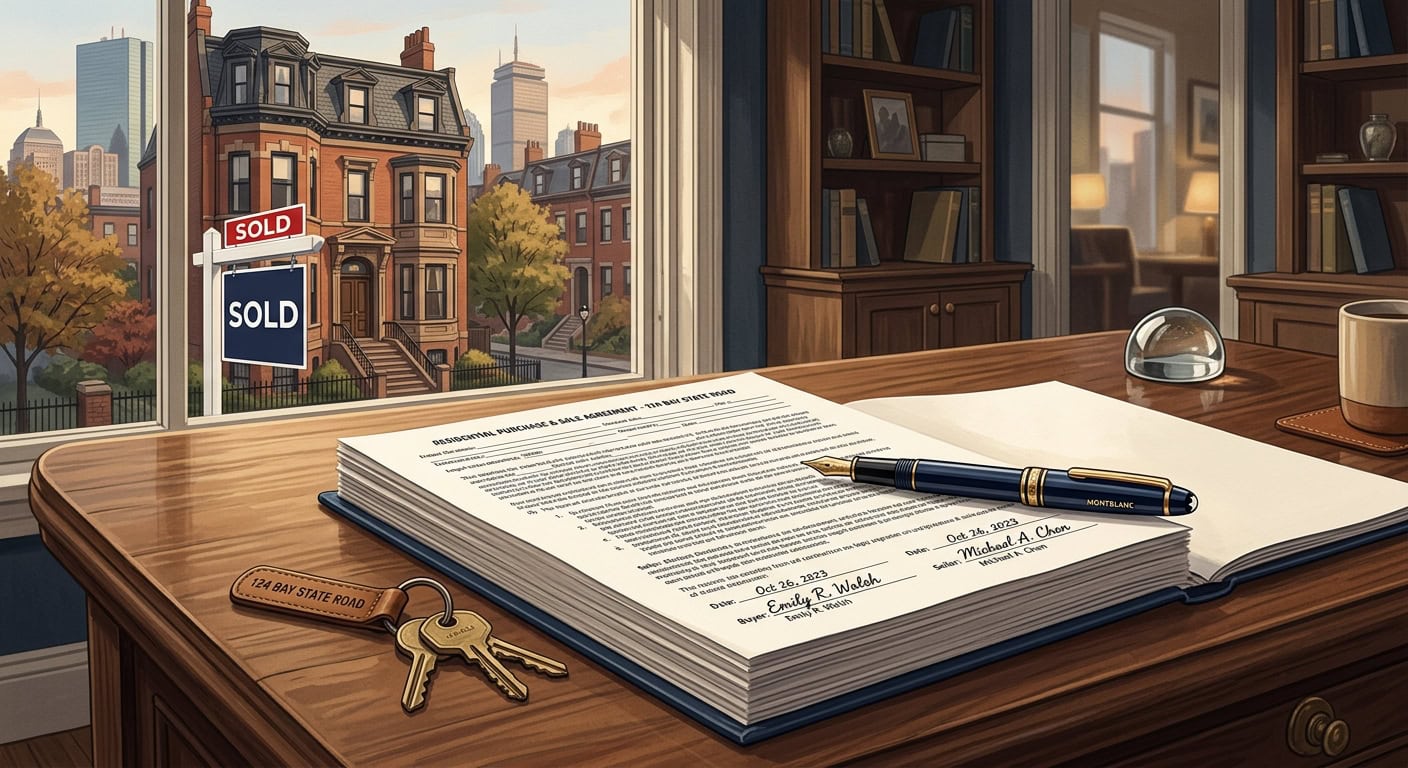
The Purchase and Sale Agreement is the binding contract that governs a Massachusetts home sale. It is prepared by both parties’ attorneys and signed approximately 10 to 14 days after the Offer to Purchase is accepted. Unlike in many other states, Massachusetts follows a two-document process: the Offer to Purchase sets the initial terms, and the P&S is the full, enforceable contract. Once you sign the P&S as a seller, you have committed to a closing date, a final price, a set of seller obligations, and a clear default structure if either party fails to perform.
What Is the Massachusetts Purchase and Sale Agreement and What Does It Mean for Home Sellers?
If you’ve accepted an offer on your Boston home, you already know about the Offer to Purchase. But the document that actually runs your transaction is the Purchase and Sale Agreement, and many sellers sign it without fully understanding what they’ve just committed to. The P&S is a dense legal contract, and reviewing it is exactly what your attorney is paid to do. But as the seller, you should understand the framework before it lands in your inbox. For the step before this one, see how the Massachusetts Offer to Purchase works. For everything that follows the signed P&S, see what happens after you accept an offer in Massachusetts.
How the P&S Fits Into a Massachusetts Home Sale
Massachusetts uses a two-contract structure that sets it apart from most states. The Offer to Purchase (OTP) establishes the price, deposit amount, proposed closing date, and contingencies. The OTP is legally binding once both parties sign it. The Purchase and Sale Agreement is the full contract. It covers everything the OTP started and then adds: final price and closing date, seller obligations from now until closing, exact contingency terms and deadlines, the mortgage commitment deadline if the buyer is financing, what personal property and fixtures convey, title requirements, and default remedies if either party fails to close.
You’ll typically receive the first draft of the P&S from the buyer’s attorney within a week of accepting the offer. Your attorney will review it, negotiate modifications, and send back a redlined version. This back-and-forth happens before either party signs.
What You’re Committing To as a Seller
The smoke and CO certificate. Massachusetts law requires that your local fire department inspect the property to ensure working smoke and carbon monoxide detectors are in place before closing. In Boston, this is handled by the Boston Fire Department. Scheduling falls on you as the seller, and BFD appointments book out quickly in busy markets. Get on the calendar as soon as you list.
The broom-clean standard. The standard P&S requires you to deliver the property in broom-clean condition at closing, free of personal property, debris, and anything not explicitly listed as conveying with the sale.
Good, clear, and marketable title. You’re warranting that you can deliver title to the property free of liens and encumbrances. Your attorney handles this by obtaining a mortgage payoff statement and resolving any outstanding liens.
Time is of the essence. If the P&S includes a “time is of the essence” provision, the closing date is a hard deadline. Missing it without a written extension signed by both parties can put either side in breach. Massachusetts courts take this more seriously than sellers sometimes expect.
What Your Attorney Negotiates Before You Sign
The financing contingency deadline. If the buyer needs a mortgage, the P&S will include a date by which they must have a written mortgage commitment from their lender. Your attorney wants this deadline set as early as possible so you’re not left in limbo if the buyer’s financing falls through.
The closing date. Your attorney will make sure the proposed closing date works with your timeline: your next purchase if you’re buying simultaneously, your movers, and any bridge financing you may have in place.
The deposit amount. The P&S typically calls for a larger deposit than the OTP, often bringing the total to 5% of the purchase price, held in escrow. If the buyer defaults after the P&S is signed and there is no valid contingency exit, you generally keep the deposit.
Personal property inclusions and exclusions. If there’s any question about what stays with the house, the P&S is where it gets settled in writing. Disputes over excluded items have derailed or delayed plenty of closings.
The Deposit and Default: What Happens If the Buyer Walks
If the buyer backs out after the P&S is signed and they don’t have a valid contingency to excuse them, you are typically entitled to keep the deposit as liquidated damages. On a $780,000 sale in Jamaica Plain with a 5% total deposit, that’s $39,000 that stays with you.
The flip side: if you back out without a valid contractual basis, the buyer can pursue legal remedies, including potentially suing for specific performance or monetary damages. Sellers rarely get to simply walk away from a signed P&S without real consequences.
What Contingencies Remain After You Sign
If your buyer is financing the purchase, the P&S will carry at least one remaining contingency: the mortgage contingency. This gives the buyer a contractual right to exit if their lender fails to issue a written commitment by the deadline specified in the P&S. Other contingencies, including the home inspection contingency, are typically resolved before the P&S is signed. Most buyers in Boston’s current market conduct their inspection during the OTP period and negotiate any credits or repairs before the P&S is drafted.
Frequently Asked Questions
What is the difference between the Offer to Purchase and the Purchase and Sale Agreement in Massachusetts?
The Offer to Purchase (OTP) is the initial contract that establishes price, deposit, proposed closing date, and basic contingencies. It’s legally binding once signed, but it’s a shorter, less detailed document. The Purchase and Sale Agreement is the full governing contract, drafted and negotiated by attorneys, that adds seller obligations, exact contingency deadlines, title requirements, and default remedies. In a standard Massachusetts transaction, you sign both.
When is the P&S signed relative to the accepted offer?
The P&S is typically signed 10 to 14 days after the accepted Offer to Purchase, sometimes faster in competitive situations. This window is used for attorney review and negotiation, inspection completion, and resolution of any inspection findings. If the P&S signing is delayed and the parties agree to extend the OTP period, that extension should be in writing.
Can a seller back out of a signed Purchase and Sale Agreement in Massachusetts?
Not easily, and not without legal risk. Once the P&S is signed, it is a binding contract. If a seller attempts to back out without a valid contractual basis, the buyer can sue for specific performance or damages. Sellers who need to exit a signed P&S should speak with their attorney before taking any action.
What happens to the deposit if the buyer defaults after the P&S is signed?
If the buyer defaults after the P&S is signed and there is no valid contingency to excuse them, the seller is typically entitled to retain the deposit as liquidated damages. The exact amount and the conditions under which the seller can retain it will be defined in the contract language your attorney negotiated.
Does a Massachusetts seller need to attend the closing in person?
Not necessarily. In Massachusetts, it’s common for the seller to sign the quitclaim deed and closing documents at their own attorney’s office before or on the day of the closing appointment. Some sellers grant their attorney power of attorney to sign on their behalf. Your attorney will walk you through the specifics well before closing day.
Have questions? Let’s connect.
About Juan Murray
Juan Murray is a Boston broker associate with more than 30 years of experience helping buyers, sellers, and investors across Greater Boston, personally leading every transaction from the first conversation through closing.
RE/MAX Real Estate Center · (617) 721-0961
Equal Housing Opportunity. Juan Murray is licensed as a Broker in Massachusetts, regulated by the Massachusetts Board of Registration of Real Estate Brokers and Salespersons. This article is general information only and does not constitute legal, tax, or financial advice. Confirm your specific costs and obligations with your closing agent, tax advisor, or lender.