Real Estate, Simplified ….

Boston-area real estate, simplified

Real Estate, Simplified ….

Boston-area real estate, simplified

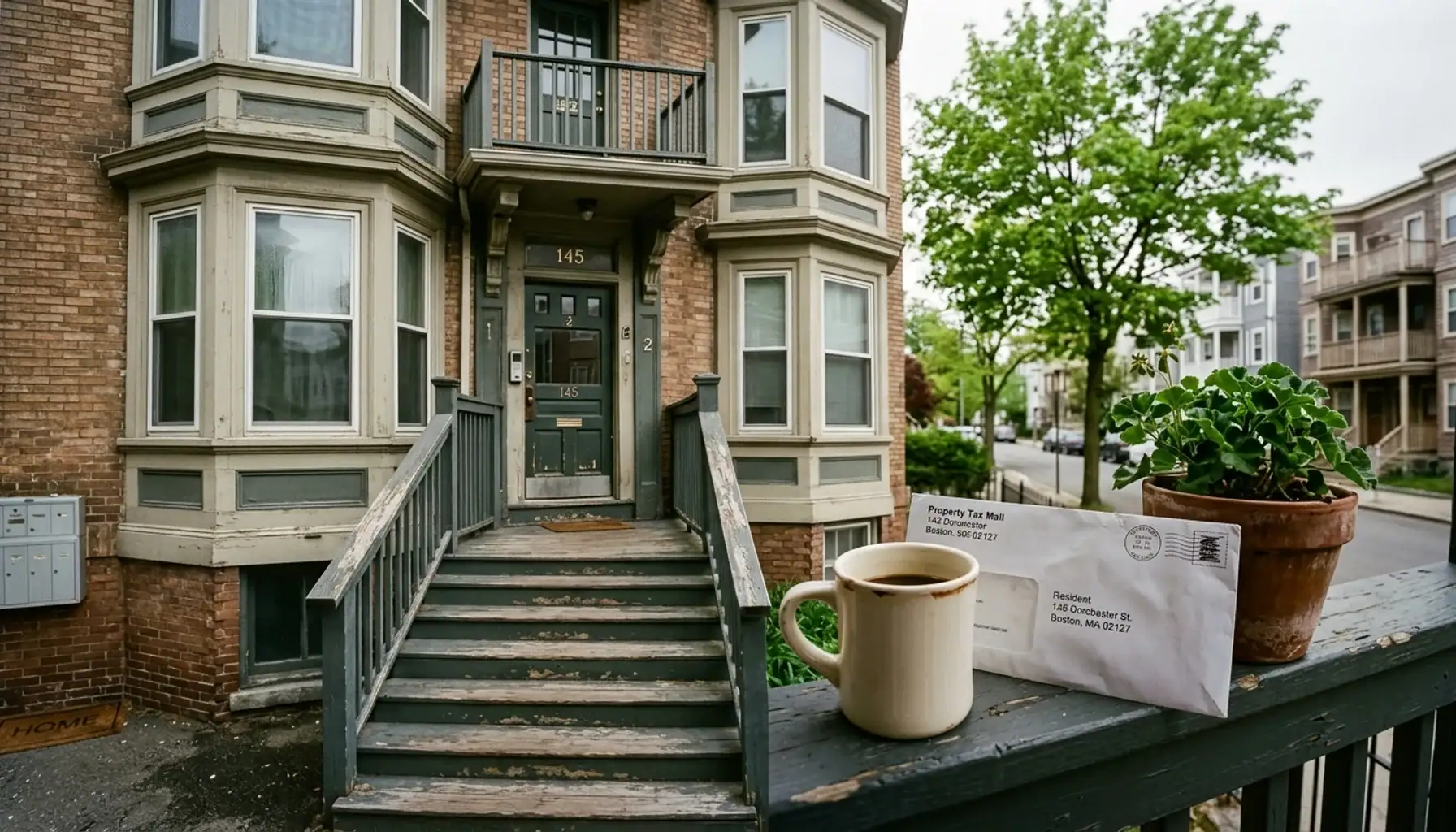
Boston triple-decker stoop with property tax mail, illustrating the Boston residential tax exemption savings guide

Boston Residential Tax Exemption: 2026 Savings Guide

The Boston residential tax exemption can save qualifying owner-occupants up to $4,353.74 on their Fiscal Year 2026 property tax bill by excluding up to $351,108 of assessed value from taxation. You must own and occupy the property as your principal residence as of January 1, 2025, and file with the Boston Assessing Department by April 1, 2026

  • The FY2026 Boston residential exemption saves eligible owner-occupants up to $4,353.74, based on an exempt value of $351,108 at a $12.40 tax rate per thousand.

  • Eligibility requires owning and occupying the property as your principal residence in Jamaica Plain, Roslindale, Hyde Park, Dorchester, Roxbury, or anywhere else in Boston as of January 1, 2025.

  • The application deadline for FY2026 is April 1, 2026; forms become available after the third-quarter tax bill mails in late December.

  • Condos, single-family homes, and multi-family properties all qualify, but only if the owner occupies one unit as their primary residence.

  • You can only claim the exemption on one property in the City of Boston, and it cannot be applied retroactively to prior fiscal years.

  • The exemption is separate from a tax abatement and from the state’s senior circuit breaker tax credit, though homeowners can potentially use more than one program.

If you closed on a triple-decker in Dorchester last spring or bought a condo in Jamaica Plain and moved in right before the new year, you’ve probably heard other owners mention this exemption without fully understanding the mechanics. Boston’s residential exemption isn’t automatic. You have to file for it every year, and the eligibility window is stricter than most first-time buyers assume.

This guide walks through exactly who qualifies for FY2026, how the savings are calculated, which documents the Assessing Department requires, and where owners are commonly denied or miss the deadline entirely. As of 2026, the exemption remains one of the most underused tax breaks among Boston homeowners, largely because the application window closes quietly in early spring, well before most people think about property taxes at all.

What Is the Boston Residential Exemption for 2026 and How Much Can You Save?

The Boston residential exemption is a property tax reduction available to owner-occupants that excludes a portion of a home’s assessed value from taxation. For Fiscal Year 2026 (July 1, 2025, through June 30, 2026), the maximum exempt value is $351,108, which, at Boston’s residential tax rate of $12.40 per thousand, produces a maximum savings of $4,353.74 per year.

Not every qualifying owner gets the full amount. The savings scale with your property’s assessed value relative to the exempt threshold, so a condo assessed well below $351,108 sees the exemption wipe out a larger share of its taxable value than a $1.2 million triple-decker would. Specifically, the exemption cannot reduce a property’s taxable value below 10 percent of its full assessment, a floor the City of Boston Assessing Department built in to prevent the exemption from eliminating tax liability.

The exemption is authorized under Massachusetts General Laws Chapter 59, Section 5C, and the City of Boston administers it through a home-rule petition that caps the exempt portion at 35 percent of the average assessed value of Class One Residential parcels citywide. As a result, the dollar figure shifts modestly year to year as citywide assessments move. FY2026’s $4,353.74 maximum is higher than in prior years, reflecting continued growth in average residential assessments across neighborhoods like Roxbury and Hyde Park.

How to Qualify for Primary Residence Exclusion in Boston?

Qualifying for the residential exemption requires that you both own the property and occupy it as your principal residence, meaning the address you use to file your Massachusetts state income tax return. Boston’s Assessing Department checks ownership as of January 1, 2025, for the FY2026 exemption cycle, so the timing of your closing date matters more than most buyers realize.

First, if you owned and occupied your home on January 1, 2025, you’re eligible outright. Additionally, if you purchased and moved into your principal residence between January 1 and June 30, 2025, you may still qualify for FY2026 under a secondary provision the city built in for recent buyers. This detail gets missed constantly, and it’s exactly the kind of nuance we walk Jamaica Plain and Dorchester buyers through when timing a purchase around the fiscal year calendar.

For FY2027, the equivalent window shifts forward: owners who recorded a deed at the Suffolk County Registry of Deeds and moved in between January 1 and June 30, 2026, may qualify. Notably, you can only claim the exemption on one property citywide, even if you own multiple residential units across Roslindale, Hyde Park, or elsewhere in Boston. Investment properties, second homes, and units you don’t personally occupy are excluded entirely, regardless of how long you’ve owned them.

Does Massachusetts Have Property Tax Exemptions Beyond Boston’s Program?

Massachusetts law authorizes multiple property tax relief programs beyond Boston’s residential exemption, including statewide senior exemptions, veteran exemptions, and the senior circuit breaker tax credit administered through state income tax filings. Boston’s residential exemption is a municipal program specific to owner-occupants, separate from these state-level benefits, and homeowners can often combine programs where eligibility overlaps.

The senior circuit breaker tax credit, claimed via the circuit breaker tax credit form on your Massachusetts income tax return, works independently of Boston’s municipal exemption and targets seniors whose property tax bill exceeds a set percentage of their income. Unlike the residential exemption, it’s a state income tax credit, not a reduction applied directly to your city tax bill. For seniors in Hyde Park or Roslindale weighing both options, it’s worth checking eligibility for each separately, since qualifying for one doesn’t disqualify you from the other.

Neighboring municipalities administer their own versions of the residential exemption under the same M.G.L. Ch. 59 framework. The Brookline residential exemption, for example, follows a similar owner-occupant structure but uses different exempt values tied to Brookline’s own assessed property data, distinct from Boston’s $351,108 FY2026 figure. If you’re comparing a move between Boston neighborhoods and nearby towns, don’t assume the numbers transfer directly. Each city sets its own exempt percentage and rate independently.

What Is a $12,000 Property Tax Exemption and How Does It Compare to Boston’s Program?

References to a flat “$12,000 property tax exemption” typically refer to smaller, fixed-dollar exemption programs offered in some Massachusetts towns for seniors, veterans, or disabled homeowners, which are structured differently from Boston’s percentage-based residential exemption. Boston’s program doesn’t use a flat dollar exemption at all; instead, it excludes a set portion of assessed value ($351,108 for FY2026) before applying the tax rate, which is why the resulting savings figure varies by rate year rather than staying fixed.

This distinction trips people up during research. A flat exemption subtracts the same dollar amount from every qualifying property’s tax bill regardless of the property’s assessed value. Boston’s value-based exclusion, by contrast, means two owner-occupants with different home values receive different exemption amounts as a percentage of their bill. However, the maximum dollar savings cap is $4,353.74 for FY2026, regardless of how high your assessment runs above $351,108.

Separately, some homeowners search for property tax breaks for seniors expecting a fixed number like $12,000. Boston does not offer a standalone $12,000 exemption; seniors here typically layer the standard residential exemption with either a state-level senior exemption or the circuit breaker credit, producing combined savings that can exceed a flat figure in many cases, though never guaranteed and always dependent on individual assessment and income circumstances.

What Is the Step-by-Step Application Process for the Residential Exemption?

Applying for Boston’s residential exemption requires confirming eligibility, gathering ownership and occupancy documents, downloading the appropriate fiscal-year form, and submitting it to the Assessing Department before the April 1 deadline. The full process typically takes under an hour once you have your paperwork organized, though the city processes applications on a rolling basis through the deadline.

  1. Confirm your eligibility date. Verify you owned and occupied the property as of January 1, 2025 (or fall under the mid-year 2025 provision described above) for FY2026.

  2. Check your property record. Use the Boston Property Lookup tool at cityofboston.gov/assessing/search to confirm your assessed value and see whether an exemption already appears on file.

  3. Wait for the third-quarter tax bill. The application form becomes available after this bill mails in late December, since the form ties to that specific fiscal year’s figures.

  4. Download and complete the residential exemption application through the Property Lookup tool or in person at the Assessing Department.

  5. Gather proof of ownership (your deed or closing statement) and proof of occupancy (Massachusetts driver’s license or state ID showing the property address, plus a utility bill, voter registration, or vehicle registration as backup).

  6. Submit the completed application in person at the Assessing Department, Room 301, 1 City Hall Square, Boston, MA 02201, or by mail to the same address.

  7. File before April 1, 2026. Late applications are generally not accepted, so build in buffer time if you’re mailing rather than delivering in person.

If you’re unsure whether your paperwork is sufficient, the Taxpayer Referral and Assistance Center, known as TRAC, sits on City Hall’s mezzanine level and can walk you through documentation questions directly at 617-635-4287. We routinely point Roxbury and Dorchester clients toward TRAC when their occupancy proof is unusual, for example, when a deed lists a trust rather than an individual name.

What Documents Do I Need to Apply for the Boston Residential Exemption?

The Boston Assessing Department requires two categories of documentation for a residential exemption application: proof of ownership and proof of occupancy. Proof of ownership means your recorded deed or the closing (HUD-1 or Closing Disclosure) statement from your purchase. In contrast, proof of occupancy establishes that you actually live at the property as your principal residence.

For occupancy, the strongest single document is a Massachusetts driver’s license or state identification card listing the property address. If your ID hasn’t been updated yet, which is common for buyers who closed within the last several months, the Assessing Department will typically accept a combination of secondary documents: a recent utility bill in your name at the address, voter registration confirming the same address, or vehicle registration. For multi-family owners occupying one unit in a two- or three-family property, expect additional scrutiny on which specific unit you occupy, since only your unit’s proportional share of value qualifies.

Trusts and life estates require additional documentation to demonstrate that the beneficiary or life tenant is the individual occupying the property, because the exemption applies to a natural person’s principal residence rather than to the trust entity itself. If your property title sits inside a trust, which is increasingly common among Jamaica Plain and Hyde Park homeowners doing estate planning, bring the trust document itself along with standard occupancy proof when you file.

What Are Common Reasons Applications Are Denied and How Do I Appeal?

Boston residential exemption applications are most commonly denied for three reasons: missing the January 1 (or mid-year 2025) occupancy deadline, submitting mismatched proof of occupancy that doesn’t match the deed’s ownership name, and applying for a property that isn’t the owner’s documented principal residence for state tax filing purposes. Each of these is preventable with the right documentation upfront.

A frequent mistake among recent Dorchester and Roslindale buyers involves the timing rule specifically. Owners who closed in July or August 2026, for example, assume they’re covered for FY2026 because they now own and occupy the home. They aren’t, since that window falls outside both the January 1, 2026 ownership date and the January to June 2026 mid-year provision, both of which apply to FY2027. Those buyers will need to wait until they qualify under the FY2028 cycle instead.

If your application is denied, Boston offers an appeal process through the Assessing Department and, in some cases, through the state Appellate Tax Board if the local appeal doesn’t resolve the issue. Specifically, gather any documentation you were missing at the time of initial filing, request a written explanation of the denial reason, and file the appeal within the timeframe stated in your denial notice. In our experience advising Hyde Park and Roxbury sellers and buyers, most denials stem from a documentation gap rather than true ineligibility, which means a well-documented appeal often succeeds.

Timeline: When to Apply and When You’ll See Tax Savings?

The Boston residential exemption timeline runs on the city’s fiscal year, which starts July 1 and ends June 30, with the exemption savings appearing on the third-quarter tax bill mailed in late December. For FY2026, that means the exemption will be reflected on the bill issued around late December 2025, with the April 1, 2026, deadline serving as your last chance to file if you haven’t already.

Here’s how the sequence typically plays out. First, you establish eligibility based on your January 1 ownership and occupancy status. Then, the city issues preliminary tax bills over the summer and fall based on the prior year’s assessed value, before the third-quarter bill arrives with the updated assessment and any exemption applied. As a result, if you’re filing for the first time as a new owner-occupant, you likely won’t see the exemption credited until that December bill, even though your eligibility technically began the previous January.

This lag constantly catches new buyers off guard. You might close on a Jamaica Plain condo in March 2025, confirm you fall under the mid-year provision, file your application promptly, and still not see the savings reflected until the December 2025 third-quarter bill. Budget for full, unreduced quarterly payments in the interim, since the city doesn’t retroactively adjust earlier quarterly bills once the exemption is posted.

Senior vs. Owner-Occupant Exemptions: Key Differences Explained

Boston’s standard residential exemption and Massachusetts’ senior-specific property tax relief programs serve different populations and operate through separate mechanisms, even though both fall under the broader property tax relief umbrella. The residential exemption applies to any owner-occupant regardless of age. In contrast, senior exemptions and the circuit breaker tax credit specifically target homeowners who meet age and income thresholds set by state law.

  • Administered by: Boston Residential Exemption through the City of Boston Assessing Department; Senior Circuit Breaker Credit through the Massachusetts Department of Revenue (state income tax).

  • Age requirement: None for the Boston Residential Exemption; typically 65 or older for the Senior Circuit Breaker Credit.

  • Applied to: The Boston Residential Exemption reduces your property tax bill directly; the Senior Circuit Breaker Credit applies as a credit on your state income tax return.

  • FY2026 maximum benefit: Up to $4,353.74 for the Boston Residential Exemption; varies by income and tax bill ratio for the Senior Circuit Breaker Credit.

  • Filing deadline: April 1, 2026 for the Boston Residential Exemption; your Massachusetts state income tax filing deadline for the Senior Circuit Breaker Credit.

  • Can you combine both? Yes, in many cases, since the two programs operate through separate government channels.

Notably, a senior homeowner in Roslindale who occupies their home as a principal residence can often claim both the standard residential exemption and the circuit breaker credit in the same year, since they operate through entirely separate government channels. Neither program automatically triggers the other, so seniors need to file both applications independently if they want the combined benefit.

What Happens If Your Application Is Denied: Appeals and Next Steps?

A denied residential exemption application in Boston can typically be appealed by providing additional documentation that addresses the specific reason for the denial stated in your notice. The Assessing Department issues a written explanation with each denial, and addressing that exact gap, rather than resubmitting the same paperwork, is what determines whether an appeal succeeds.

Most successful appeals we’ve seen involve occupancy proof issues, particularly for owners of multi-family properties in Dorchester or Roxbury, where it wasn’t initially clear which unit the owner occupies. Providing a signed statement clarifying unit occupancy, along with updated utility bills for that unit, generally resolves this type of denial. If the local appeal doesn’t resolve your case, Massachusetts residents can escalate to the state Appellate Tax Board. However, this route takes considerably longer and is generally reserved for disputes involving genuine disagreement over the interpretation of eligibility rather than simple documentation gaps.

Annual Renewal Process: Keeping Your Exemption Active

The Boston residential exemption is not automatically renewed. You must reapply each fiscal year, as the city verifies ownership and occupancy annually rather than carrying over a prior year’s approval. This surprises longtime homeowners who assume that once approved, the exemption will remain in effect permanently.

Each year’s application is tied to that year’s exempt value and tax rate, both of which the city adjusts periodically. Consequently, even if nothing about your ownership or occupancy has changed since last year, you still need to submit a new application by each April 1 deadline. The good news: renewal applications for existing owner-occupants are typically faster to process than first-time filings, since your ownership and occupancy history is already on record with the Assessing Department.

Set a recurring reminder for late December, right when the third-quarter bill arrives, rather than waiting until closer to the April 1 cutoff. Owners who wait until March to gather documentation frequently discover a missing piece, like an outdated driver’s license address, that takes longer to fix than expected.

Residential Exemption vs. Abatement: Which Tax Relief Option Is Right for You?

A residential exemption and a property tax abatement solve two different problems: the exemption reduces your taxable value because you’re an owner-occupant. In contrast, an abatement challenges the accuracy of your property’s assessed value itself. You can pursue both in the same fiscal year if you believe your assessment is inflated and you also qualify as an owner-occupant.

Think of it this way. The exemption doesn’t ask whether your assessment is correct. It simply excludes a portion of whatever your assessed value is because you live there. An abatement, by contrast, argues that the city’s assessed value is too high relative to comparable sales, structural condition, or an assessment error, and, if successful, lowers the base value to which the exemption is applied.

For Roxbury and Dorchester owners who’ve seen assessed values climb sharply following new development in their area, filing an abatement alongside the standard residential exemption can meaningfully compound savings, since a lower base assessment combined with the exemption’s exclusion produces a smaller final taxable amount than either would alone. If you’re weighing whether your assessment reflects true market value, understanding how a home appraisal differs from a home inspection matters here too, since assessed value, appraised value, and inspection findings are three distinct figures that often get conflated.

How Does the Exemption Affect Property Assessment and Resale Value?

The residential exemption does not affect your property’s underlying assessed value or its resale value; it only affects the taxable portion of that value for as long as the current owner occupies the home. Once a property sells, the exemption doesn’t transfer, and the new owner must establish their own eligibility and file independently.

This matters more than most sellers realize during a transaction. A triple-decker in Roxbury with a residential exemption on file doesn’t show a “reduced” assessed value to a prospective buyer, meaning buyers evaluating comparable sales still see the property’s full assessment, not the exemption-adjusted tax bill. As a result, don’t expect the exemption to influence how a buyer’s agent or appraiser values the home during a purchase.

What does matter is the ongoing carrying costs for a new owner-occupant. If you’re buying a Hyde Park single-family and planning to occupy it, factor in that your effective tax bill will likely be lower than the seller’s most recent bill only after you successfully file and the exemption posts, typically not until the following December’s third-quarter bill, as covered above. Buyers comparing total monthly costs across properties should account for this delay when running the numbers, as well as other transaction costs covered in our guide to closing costs for Boston buyers.

Real Homeowner Examples: Tax Savings Across Different Property Values

The dollar value of Boston’s residential exemption scales differently depending on where a property’s assessed value sits relative to the $351,108 exempt threshold for FY2026. Lower-assessed condos see the exemption eliminate a larger percentage of their tax bill. In contrast, higher-value single-family and multi-family properties see the same flat-dollar savings represent a smaller share of their total bill.

  • Jamaica Plain studio/1BR condo, assessed around $350,000: the exemption offsets nearly the entire assessed value, subject to the 10% floor rule.

  • Roslindale single-family, assessed around $650,000: the exemption excludes roughly 54% of assessed value from taxation.

  • Dorchester two-family, owner-occupied unit, assessed around $780,000 total, assuming an even 50/50 unit split ($390,000 for the owner-occupied share): the exemption excludes roughly 90% of the owner’s occupied share, not 45% of the full building’s assessed value, since the exemption applies only to the owner’s occupied portion.

  • Roxbury triple-decker, assessed around $950,000 or more: the full $4,353.74 savings applies, representing a smaller percentage of the total bill.

Notably, multi-family owner-occupants receive the exemption only on their proportional share of occupancy, not on the entire building’s assessed value. A three-family owner living in one of the three equal units, for example, typically has the exemption calculated against roughly one-third of the total assessment, rather than the full property value. This distinction trips up plenty of Dorchester and Roxbury landlord-occupants who assume the full exemption applies to their entire multi-family holding.

How Juan Real Estate Group Helps Boston Owners Navigate Tax Exemptions and Pricing Strategy

Juan Real Estate Group, led by Broker Associate Juan Murray of RE/MAX Real Estate Center, works directly with owner-occupants across Jamaica Plain, Roslindale, Hyde Park, Dorchester, and Roxbury who are weighing how tax exemptions, assessed values, and resale pricing fit together. Understanding your residential exemption status is one piece of a larger financial picture, and that’s exactly where pricing strategy grounded in real MLS data, not a generic online estimate, becomes valuable.

For homeowners considering a sale, Juan Murray pulls actual closed comparable sales and true absorption rates rather than relying on automated valuation tools, since a property’s exemption status has zero bearing on what a buyer will actually pay. If you’re a multi-family owner in Dorchester wondering whether your occupied unit’s exemption changes how you should price the building for sale, or a Roslindale homeowner weighing whether to file an abatement alongside your exemption before listing, a confidential consultation clarifies the numbers before you commit to anything.

This same data-driven approach extends to buyer representation, particularly for first-time buyers navigating Boston’s fiscal-year timing rules while also trying to time an offer around mortgage rate movements. Juan Murray also advises single-family homeowners in Roslindale and Hyde Park exploring ADU and value-add strategies, where understanding your current tax exemption baseline matters before adding a second unit that could shift your assessment. Unlike a citywide generalist team, Juan Real Estate Group focuses specifically on these five neighborhoods, meaning recommendations are grounded in actual local sales data rather than broad citywide averages. Other real estate resources exist for general tax exemption questions, but for a pricing strategy that accounts for your exemption status, assessed value, and resale timing together, a hyperlocal broker who studies these exact streets makes the difference.

Practical Guidance: How to Prioritize Your Application and Avoid Costly Mistakes

Successfully claiming the Boston residential exemption comes down to filing at the right time and keeping your occupancy documentation current, since most missed savings stem from procedural gaps rather than genuine ineligibility. Prioritize these steps in order of impact.

  • Confirm your January 1 eligibility date immediately after closing on any Boston property, since this single date determines your entire fiscal year eligibility window.

  • Update your driver’s license address to your new property as soon as possible after moving in. This is the single strongest occupancy document the Assessing Department accepts.

  • Mark your calendar for late December and April 1 each year, treating renewal as a recurring annual task rather than a one-time filing.

  • Don’t assume multi-family exemption calculations match single-family ones. If you own a two- or three-family and occupy one unit, expect the exemption to apply only to your proportional share.

  • Consider an abatement alongside your exemption if you believe your assessed value is inflated relative to comparable sales in Roxbury or Dorchester.

  • Don’t wait until March to gather documents. Trust-held properties, recently updated deeds, and mismatched address records take longer to resolve than owners expect.

The most common mistake we see among owners in Jamaica Plain and Hyde Park is assuming that a title company or closing attorney automatically files the exemption on their behalf. Nobody files it for you. It’s entirely the homeowner’s responsibility, every single fiscal year, regardless of how long you’ve lived at the property.

Frequently Asked Questions

How much is the Boston residential tax exemption worth in 2026?

For Fiscal Year 2026, the Boston residential exemption is worth up to $4,353.74, based on excluding up to $351,108 of assessed value from taxation at the city’s $12.40 per thousand residential tax rate. Actual savings vary depending on your property’s assessed value relative to that threshold.

Do I need to reapply for the exemption every year?

Yes. The Boston residential exemption requires a new application each fiscal year, as the city verifies ownership and occupancy annually rather than carrying forward prior approvals. Mark the April 1 deadline every year, even if nothing about your ownership situation has changed.

Can I get the residential exemption on a multi-family property?

Yes, condos, single-family homes, and multi-family properties all qualify for Boston’s residential exemption, provided the owner occupies one unit as their principal residence. For multi-family properties, the exemption typically applies only to the owner’s proportionally occupied share, not the entire building’s assessed value.

What is the difference between a residential exemption and a tax abatement in Boston?

A residential exemption excludes a portion of assessed value from taxation because you’re an owner-occupant, while a tax abatement challenges whether the city’s assessed value itself is accurate. Homeowners can pursue both in the same fiscal year, and doing so can compound savings if their assessment is genuinely inflated.

What happens if I miss the April 1 filing deadline?

Missing the April 1 deadline for Boston’s residential exemption generally means forfeiting that fiscal year’s savings entirely, since the exemption is not retroactive to prior fiscal years. You would need to wait and apply for the following fiscal year cycle instead.

Can seniors combine the residential exemption with other tax relief programs?

Yes. Senior homeowners can often combine Boston’s standard residential exemption with the Massachusetts senior circuit breaker tax credit, since the two operate through separate government channels, one through the city’s Assessing Department and one through state income tax filing. Both require independent applications.

Does the exemption transfer to a new owner when I sell my home?

No. The residential exemption does not transfer with a property sale. A new owner must establish their eligibility based on their ownership and occupancy dates, then file a new application for the fiscal year in which they qualify.

How do I check if my exemption is already showing on my property record?

You can verify your exemption status using the Boston Property Lookup tool at cityofboston.gov/assessing/search, which shows your current assessed value and any exemptions on file. If you’re unsure how to read the results, the Taxpayer Referral and Assistance Center at City Hall can walk you through your specific property record.

Conclusion: What Boston Homeowners Should Do Next

The Boston residential tax exemption remains one of the more straightforward tax relief programs available to owner-occupants in 2026, but it requires action on your part every single fiscal year. Up to $4,353.74 in FY2026 savings sits unclaimed for owners who miss the January 1 eligibility window, submit incomplete occupancy documentation, or forget that the April 1 deadline arrives earlier than most people expect.

Whether you’re a first-time buyer in Roslindale trying to understand fiscal year timing, a multi-family owner in Dorchester weighing exemption calculations against your occupied unit, or a homeowner considering an abatement alongside your exemption before listing in Jamaica Plain or Hyde Park, getting the mechanics right protects real money on your annual tax bill. As assessed values continue to shift across Boston’s neighborhoods as we head further into 2026, staying current on both your exemption status and your property’s actual market value matters more than ever.

Tax exemption status is only one input into a sound pricing or purchase decision. If you’re considering a sale, a purchase, or an ADU project anywhere in Jamaica Plain, Roslindale, Hyde Park, Dorchester, or Roxbury, get started with Juan Real Estate Group for a confidential consultation grounded in real MLS data, not guesswork.

If you’re evaluating whether your current assessed value and residential exemption status still line up with what your Jamaica Plain property could sell for today, a pricing conversation grounded in actual closed comps beats guessing every time. Schedule a free, confidential consultation with Juan Murray to talk through your specific numbers.

Written by Juan Murray, Broker Associate, RE/MAX Real Estate Center, with 30+ years of Boston real estate experience at Juan Real Estate Group