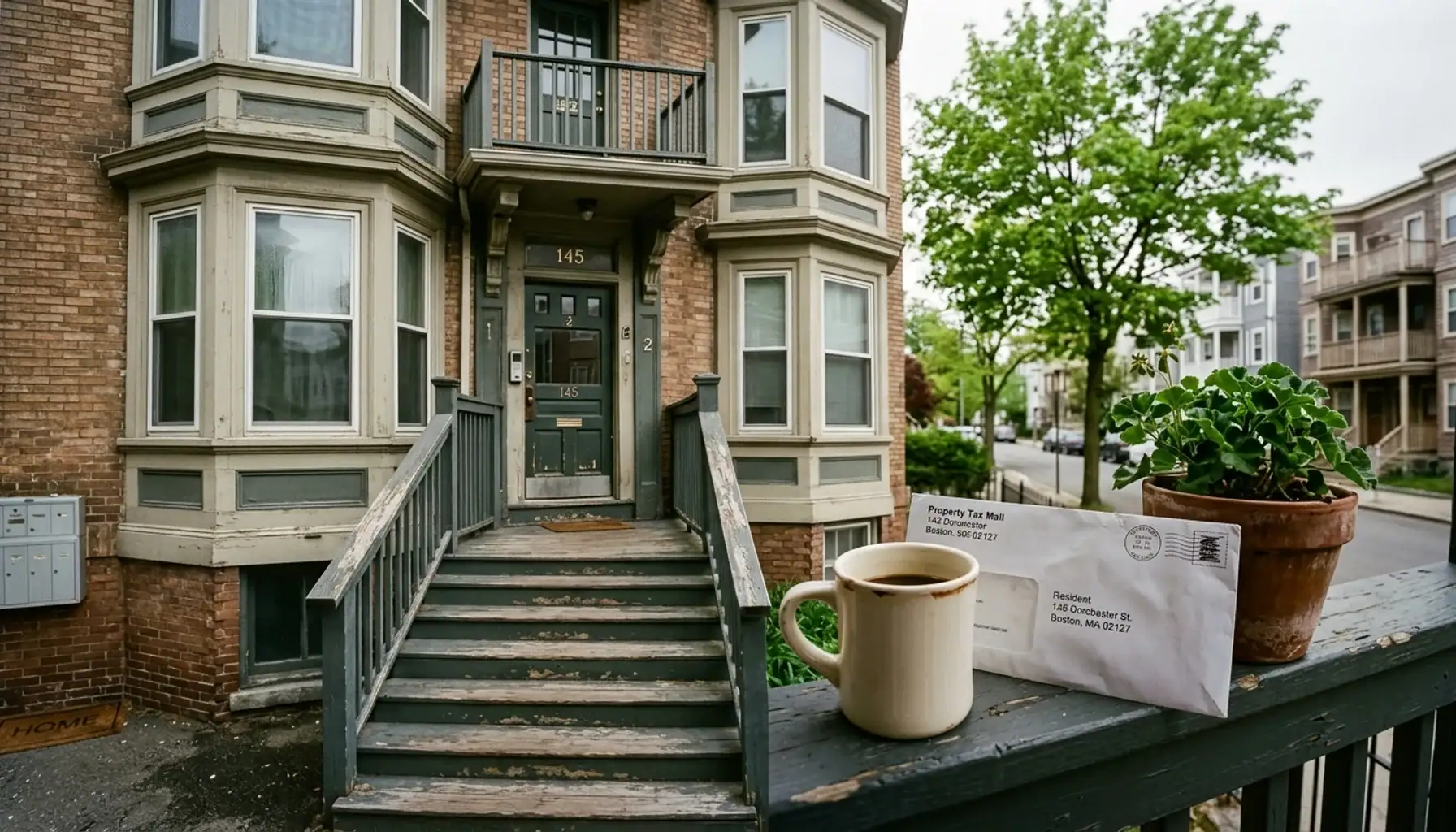
The Boston residential tax exemption can save qualifying owner-occupants up to $4,353.74 on their Fiscal Year 2026 property tax bill by excluding up to $351,108 of assessed value from taxation. You must own and occupy the property as your principal residence as of January 1, 2025, and file with the Boston Assessing Department by April 1, 2026. The exemption is not automatic and must be renewed every year.
Boston Residential Tax Exemption: What It Is and How Much You Can Save
If you closed on a triple-decker in Dorchester last spring or bought a condo in Jamaica Plain and moved in right before the new year, you’ve probably heard other owners mention this exemption without fully understanding the mechanics. Boston’s residential exemption isn’t automatic. You have to file for it every year, and the eligibility window is stricter than most first-time buyers assume. For a complete picture of what ownership costs look like when you sell, see how much you’ll actually net from a Boston home sale. And for the capital gains tax implications when you eventually sell, see capital gains tax when selling a Massachusetts home.
For Fiscal Year 2026 (July 1, 2025 through June 30, 2026), the maximum exempt value is $351,108, which at Boston’s residential tax rate of $12.40 per thousand produces a maximum savings of $4,353.74 per year. Not every qualifying owner gets the full amount. The savings scale with your property’s assessed value relative to the exempt threshold. Specifically, the exemption cannot reduce a property’s taxable value below 10 percent of its full assessment.
How to Qualify
Qualifying requires that you both own the property and occupy it as your principal residence, meaning the address you use to file your Massachusetts state income tax return. Boston’s Assessing Department checks ownership as of January 1, 2025, for the FY2026 exemption cycle. If you purchased and moved into your principal residence between January 1 and June 30, 2025, you may still qualify for FY2026 under a secondary provision. You can only claim the exemption on one property citywide, even if you own multiple residential units.
Step-by-Step Application Process
- Confirm your eligibility date. Verify you owned and occupied the property as of January 1, 2025 (or fall under the mid-year 2025 provision) for FY2026.
- Check your property record using the Boston Property Lookup tool at cityofboston.gov/assessing/search to confirm your assessed value and see whether an exemption already appears on file.
- Wait for the third-quarter tax bill. The application form becomes available after this bill mails in late December, since the form ties to that specific fiscal year’s figures.
- Download and complete the residential exemption application through the Property Lookup tool or in person at the Assessing Department.
- Gather proof of ownership (your deed or closing statement) and proof of occupancy (Massachusetts driver’s license or state ID showing the property address, plus a utility bill, voter registration, or vehicle registration as backup).
- Submit the completed application in person at Room 301, 1 City Hall Square, Boston, MA 02201, or by mail to the same address.
- File before April 1, 2026. Late applications are generally not accepted.
Multi-Family Properties: A Key Distinction
Condos, single-family homes, and multi-family properties all qualify, but only if the owner occupies one unit as their primary residence. For multi-family properties, the exemption applies only to the owner’s proportionally occupied share, not the entire building’s assessed value. A three-family owner living in one of three equal units typically has the exemption calculated against roughly one-third of the total assessment. This trips up plenty of Dorchester and Roxbury landlord-occupants who assume the full exemption applies to their entire multi-family holding.
How Savings Scale by Property Value
Jamaica Plain studio/1BR condo assessed around $350,000: the exemption offsets nearly the entire assessed value, subject to the 10% floor rule. Roslindale single-family assessed around $650,000: the exemption excludes roughly 54% of assessed value. Roxbury triple-decker assessed around $950,000 or more: the full $4,353.74 savings applies, representing a smaller percentage of the total bill. Lower-assessed properties see the exemption eliminate a larger share of their tax bill percentage-wise.
Residential Exemption vs. Tax Abatement
A residential exemption and a property tax abatement solve two different problems. The exemption reduces your taxable value because you’re an owner-occupant. An abatement challenges the accuracy of your property’s assessed value itself. You can pursue both in the same fiscal year. For Roxbury and Dorchester owners who’ve seen assessed values climb sharply following new development, filing an abatement alongside the standard residential exemption can meaningfully compound savings.
Annual Renewal and Common Mistakes
The exemption is not automatically renewed. You must reapply each fiscal year, as the city verifies ownership and occupancy annually. Set a recurring reminder for late December when the third-quarter bill arrives, rather than waiting until closer to the April 1 cutoff. The most common mistake: assuming that a title company or closing attorney files the exemption on your behalf. Nobody files it for you, every single fiscal year, regardless of how long you’ve lived at the property.
Common Denial Reasons and How to Appeal
Applications are most commonly denied for missing the January 1 occupancy deadline, submitting mismatched proof of occupancy that doesn’t match the deed’s ownership name, and applying for a property that isn’t the owner’s documented principal residence for state tax purposes. Most successful appeals involve occupancy proof issues: providing a signed statement clarifying unit occupancy, along with updated utility bills for that unit, generally resolves this type of denial.
Frequently Asked Questions
How much is the Boston residential tax exemption worth in 2026?
For Fiscal Year 2026, the Boston residential exemption is worth up to $4,353.74, based on excluding up to $351,108 of assessed value from taxation at the city’s $12.40 per thousand residential tax rate. Actual savings vary depending on your property’s assessed value relative to that threshold.
Do I need to reapply for the exemption every year?
Yes. The Boston residential exemption requires a new application each fiscal year, as the city verifies ownership and occupancy annually rather than carrying forward prior approvals. Mark the April 1 deadline every year, even if nothing about your ownership situation has changed.
Can I get the residential exemption on a multi-family property?
Yes, condos, single-family homes, and multi-family properties all qualify, provided the owner occupies one unit as their principal residence. For multi-family properties, the exemption typically applies only to the owner’s proportionally occupied share, not the entire building’s assessed value.
What is the difference between a residential exemption and a tax abatement in Boston?
A residential exemption excludes a portion of assessed value from taxation because you’re an owner-occupant, while a tax abatement challenges whether the city’s assessed value itself is accurate. Homeowners can pursue both in the same fiscal year, and doing so can compound savings if their assessment is inflated.
What happens if I miss the April 1 filing deadline?
Missing the April 1 deadline generally means forfeiting that fiscal year’s savings entirely, since the exemption is not retroactive to prior fiscal years. You would need to wait and apply for the following fiscal year cycle instead.
Can seniors combine the residential exemption with other tax relief programs?
Yes. Senior homeowners can often combine Boston’s standard residential exemption with the Massachusetts senior circuit breaker tax credit, since the two operate through separate government channels. Both require independent applications.
Does the exemption transfer to a new owner when I sell my home?
No. The residential exemption does not transfer with a property sale. A new owner must establish their eligibility based on their own ownership and occupancy dates, then file a new application for the fiscal year in which they qualify.
Have questions? Let’s connect.
About Juan Murray
Juan Murray is a Boston broker associate with more than 30 years of experience helping buyers, sellers, and investors across Greater Boston, personally leading every transaction from the first conversation through closing.
RE/MAX Real Estate Center · (617) 721-0961
Equal Housing Opportunity. Juan Murray is licensed as a Broker in Massachusetts, regulated by the Massachusetts Board of Registration of Real Estate Brokers and Salespersons. This article is general information only and does not constitute legal, tax, or financial advice. Confirm your specific costs and obligations with your closing agent, tax advisor, or lender.