Real Estate, Simplified ….

Boston-area real estate, simplified

Real Estate, Simplified ….

Boston-area real estate, simplified

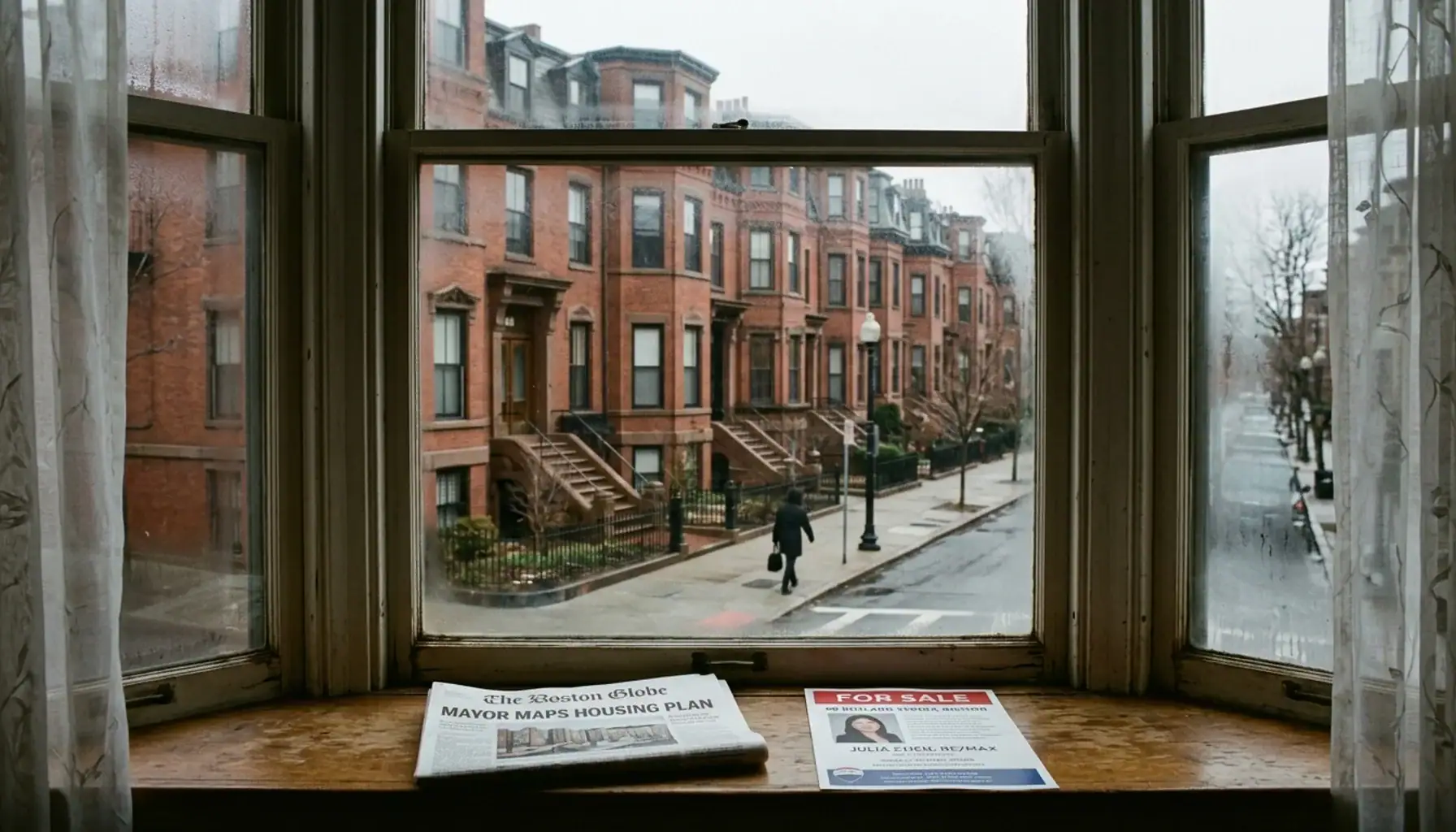
Boston brownstone street view through a window, illustrating whether to buy a home in Boston now or wait for lower rates

Buy a Home in Boston Now or Wait for Lower Rates?

For most financially prepared buyers, waiting to buy a home in Boston now or waiting for lower rates isn’t the coin flip it feels like: the math usually favors buying now. Massachusetts mortgage rates have held in the mid-6 percent range through 2026, and most forecasts expect only a modest dip by year-end, not the dramatic drop many buyers are holding out for. Meanwhile, prices in neighborhoods like Jamaica Plain keep climbing, and inventory keeps tightening, so the cost of waiting often outweighs whatever rate relief eventually shows up.

  • A quarter to half point of rate relief on a $700,000 loan saves roughly $200 a month, a real number, but often smaller than the price appreciation buyers absorb while waiting.

  • According to a U.S. News Spring Homebuying Survey, 62 percent of 2026 buyers said they were waiting for rates to drop, down from 80 percent the prior year, yet a large share of 2025 waiters later said they regretted the delay.

  • Jamaica Plain condos and single-family homes are both closing near or above list price in under a month, a clear signal of a seller’s market, not a buyer’s market.

  • The Boston Globe has reported that tens of thousands of Greater Boston households who could afford an entry-level home in 2021 could no longer afford that same home a few years later, illustrating how price appreciation, not rates, does the real damage.

  • “Buy now, refinance later” only works if you can genuinely afford the home at today’s rate; a future refinance should be treated as a bonus, not a plan.

  • First-time buyers weighing this decision should check current state and city assistance programs before assuming they’re on their own financially.

If you’re reading this in 2026 trying to decide whether to make an offer in Jamaica Plain, Roslindale, Hyde Park, Dorchester, or Roxbury, or to sit tight until mortgage rates ease, you’re not alone. This is the single most common question I field in consultations right now, and it deserves a straight answer built on actual numbers, not a headline about the Fed.

At Juan Real Estate Group, we’ve walked dozens of buyers through this exact decision this year, and the pattern is consistent: the people who wait for a specific rate number, rather than for their own financial readiness, tend to end up paying more for less. This article breaks down what waiting has actually cost buyers over the past year, what’s happening in the neighborhoods I work in weekly, and where the “buy now, refinance later” strategy actually falls apart.

What Has Waiting for Rates Actually Cost Boston Buyers?

Waiting for lower mortgage rates has cost many 2025 buyers real purchasing power, not savings, according to buyer sentiment data. A U.S. News Spring Homebuying Survey found that 62 percent of people planning to buy in 2026 said they were waiting for rates to drop first, down from 80 percent the year before. Of buyers who made that same choice in 2025, a notable share later said they regretted it.

The logic sounds reasonable on its face. Rates feel elevated, so holding off seems like the disciplined move. But waiting isn’t a neutral, no-cost decision. It’s a bet, specifically a bet that home prices in your target neighborhood will stay flat or fall while rates improve. In Jamaica Plain and Roslindale right now, that’s not the bet the data supports.

As of mid-2026, the 30-year fixed rate in Massachusetts has been sitting in the mid-6 percent range. Forecasts for the remainder of the year are narrow: most major forecasters, including Fannie Mae and the Mortgage Bankers Association, are calling for rates to hover close to current levels through the back half of the year, with only the more optimistic projections pointing toward a meaningfully lower number by December. Split the difference across these forecasts, and you’re looking at maybe a quarter to half a point of relief, if it materializes at all.

Here’s what that quarter point actually buys you in practice. On a $700,000 loan, moving from 6.5 percent to 6.0 percent saves roughly $200 per month. That’s real money, and I won’t pretend otherwise. But it’s smaller than most buyers assume they’re holding out for, and it doesn’t account for what happens to the purchase price while you wait for that number to show up.

The Boston Globe has reported that a substantial number of Greater Boston households who could afford an entry-level home in 2021 could no longer afford that same home just a few years later. That’s the actual mechanism working against buyers who wait. Rates dominate the headlines, but price appreciation quietly prices people out while they’re watching a Fed announcement.

How Tight Is Inventory in Jamaica Plain and Roslindale Right Now?

Jamaica Plain is running with roughly two to three months of housing supply across single-family homes and condos in 2026, a level that firmly describes a seller’s market rather than a buyer’s market. Inventory has dipped below one month at points this year, meaning well-priced listings are moving faster than new ones come on.

This isn’t an abstract, citywide talking point. It’s what I see block by block in Jamaica Plain, Roslindale, Hyde Park, Dorchester, and Roxbury every week. A few data points worth sitting with from the first half of 2026:

  • Jamaica Plain condos are closing at an average of just above 101 percent of list price, typically within about a month of listing.

  • Jamaica Plain single-family homes are closing close to 100 percent of list price, in a similarly short window.

  • Median Jamaica Plain home prices have risen meaningfully year over year, continuing a multi-year trend rather than a one-time spike.

Roslindale and Dorchester are showing comparable momentum. Multiple independent market reports this year have pointed to both neighborhoods outperforming the citywide average on price growth. That tracks with what happens in actual showings: a well-priced two-family in Roslindale or a Dorchester triple-decker in solid condition rarely lingers, and buyers who hesitate on a first look often come back to a higher price or a home that’s already under agreement.

So when you set “wait for rates to ease” against “prices keep climbing while I wait,” you’re not weighing a small savings against nothing. You’re weighing a modest, uncertain rate improvement against a fairly consistent, ongoing price increase in a market with genuinely limited supply. For most buyers targeting these five neighborhoods, that comparison doesn’t favor waiting.

Is “Buy Now, Refinance Later” a Safe Strategy?

Buy now, refinance later means purchasing a home at today’s mortgage rate with the plan to refinance once rates drop. Still, the strategy only works if the home is affordable at the current rate without a refinance ever happening. Treating a future rate drop as a certainty, rather than a possibility, is where this plan tends to go wrong for buyers.

Plenty of buyers are stretching their budget today on the assumption that relief is coming in the form of a future rate drop. It might arrive. It might not, or it might arrive too slowly to matter, and refinancing is never guaranteed just because a buyer wants it to happen.

A few conditions have to line up before a refinance actually benefits you:

  1. Rates need to drop enough to justify the closing costs of a new loan, typically a noticeable move rather than a token quarter point.

  2. You still have to qualify at the time of refinancing. A job change, a dip in credit score, or added debt can close that door even if rates fall.

  3. Your home’s value has to hold up. If it hasn’t appreciated as expected, you may need mortgage insurance or cash at closing to refinance at all.

The safer version of this approach, sometimes summarized as “marry the house, date the rate,” only works if you buy something you can genuinely afford at today’s rate and treat any future refinance as a bonus rather than a requirement. You can refinance your interest rate. You cannot refinance your purchase price. In a market like Jamaica Plain or Roslindale, where prices are still climbing, that purchase price is the part working against you the longer you wait.

How Do Boston’s Mortgage Rate Forecasts Compare for the Rest of 2026?

Boston-area mortgage rate forecasts for the remainder of 2026 cluster in a narrow band, with most major forecasters expecting rates to stay close to current mid-6 percent levels rather than dropping sharply. This narrow range matters because it tells you how much upside there realistically is to waiting.

The table below lays out how the math changes at different rate scenarios on a representative $700,000 loan, a common price point for a two-family or single-family home in Jamaica Plain or Roslindale.

  • 6.5% (current range): approximately $4,424/month (P&I) on a $700,000 loan. Baseline, no savings. Most likely scenario per major forecasters.

  • 6.25%: approximately $4,310/month, about $114/month lower than 6.5%. Possible by late 2026.

  • 6.0%: approximately $4,197/month, about $227/month lower than 6.5%. An optimistic scenario.

  • 5.7%: approximately $4,063/month, about $362/month lower than 6.5%. Bankrate’s 2026 forecast projects this as the year’s likely low; most other forecasters consider it the least likely scenario.

Notice that even the most optimistic scenario saves you a few hundred dollars a month, an amount that a single year of Jamaica Plain price appreciation can erase in home value alone. That’s the trade-off buyers need to weigh honestly, not the rate number in isolation.

What Should First-Time Buyers Prioritize Before Deciding?

First-time Boston buyers should prioritize their own financial readiness, not a specific mortgage rate target, when deciding whether to buy in 2026. That means confirming a comfortable monthly payment, understanding closing costs, and knowing which assistance programs you actually qualify for before you start touring homes.

A few practical steps worth working through in order:

  1. Get pre-approved, not just pre-qualified. A pre-approval gives you an actual number to compare against Jamaica Plain and Roslindale list prices, rather than a rough estimate.

  2. Check current first-time buyer assistance programs. Massachusetts and Boston-specific programs shift eligibility and funding throughout the year, so confirm what’s open before assuming you’re financing this entirely alone. My guide to Massachusetts first-time homebuyer programs for 2026 breaks down what’s currently available.

  3. Budget for closing costs separately from your down payment. These are frequently underestimated and can catch first-time buyers off guard at the closing table; my closing costs guide for Boston buyers walks through typical line items.

  4. Understand the inspection process before you write an offer. Massachusetts banned inspection waivers as of October 2025, which changes offer strategy in a multiple-offer situation; see my breakdown of home appraisal vs. home inspection in Boston for how the two processes differ.

Common mistakes I see repeatedly: buyers who wait for a rate number instead of a readiness milestone, buyers who skip the inspection process entirely under time pressure, and buyers who don’t account for triple-decker or two-family quirks like separate utility meters or shared systems until after they’re under agreement.

What Are the Real Trade-offs of Buying Now vs. Waiting?

Buying now locks in today’s price with a known, if elevated, rate; waiting risks a higher price with an uncertain rate benefit that may never fully materialize. Neither path is risk-free, and the right choice depends heavily on how long you plan to stay in the home and how tight your monthly budget is.

  • Purchase price: Buy now locks it in at today’s level. Waiting risks a likely higher price in JP, Roslindale, and Dorchester given current price trends.

  • Monthly payment: Buy now means a higher rate but a known cost. Waiting means a possibly lower rate but unknown timing.

  • Inventory competition: Buy now puts you in the game amid current tight supply. Waiting means supply likely stays tight or tightens further.

  • Refinance potential: Buy now leaves the door open to refinance if rates drop and you still qualify. Waiting means this is not applicable since you have not purchased.

  • Best fit for: Buy now suits buyers staying 5+ years with a comfortable payment today. Waiting suits buyers with genuine short-term uncertainty about income or relocation.

If your payment is comfortable today and you plan to stay in the home five or more years, buying now and refinancing opportunistically later is usually the stronger financial move. That’s not a guarantee of any specific outcome; it’s a pattern I see consistently across the transactions our team at Juan Real Estate Group works on in Jamaica Plain, Roslindale, Hyde Park, Dorchester, and Roxbury.

Does This Decision Change for Investors and Triple-Decker Buyers?

Investors weighing a triple-decker or two-family purchase in Roxbury or Dorchester face a slightly different calculation than owner-occupant buyers, since rental income can offset a higher rate in ways an owner-occupant’s budget cannot. Cash flow, not just monthly payment comfort, becomes the deciding variable.

For an investor evaluating a three-unit property with tenants already in place, the rate environment matters less than accurately pricing each unit’s lease terms and confirming the building’s true absorption potential if you ever need to sell. If you’re weighing whether to sell a rental property with existing tenants, Massachusetts law has specific requirements you’ll want to understand before listing.

Out-of-state investors evaluating Boston triple-deckers remotely face an added layer of risk here: without local eyes on the ground, it’s easy to misjudge a building’s condition, zoning potential, or true rent roll. This is a case where a hyperlocal broker who tracks these exact five neighborhoods, not a citywide generalist, changes the outcome of the deal.

Data and Evidence Snapshot for 2026

The numbers behind this decision are worth restating plainly, since they’re the foundation for everything above. As shown in the forecast table earlier, rate relief through the rest of 2026 is likely to be modest, in the range of a quarter to half a point according to consensus forecaster estimates.

Meanwhile, Jamaica Plain’s sub-month to three-month supply range, paired with condos and single-family homes both closing at or above list price, describes a market where waiting rarely produces a better outcome for the average buyer. Roslindale and Dorchester are tracking similarly according to multiple independent market reports this year.

These are the exact data points I walk clients through during a consultation, comparative market analysis in hand, rather than a generic online estimate that ignores triple-decker layouts or condo fee structures. If you’re trying to figure out what a specific property is actually worth in this environment, that’s a conversation worth having before you make any offer or listing decision.

Frequently Asked Questions

Will mortgage rates drop significantly by the end of 2026?

Most major forecasters expect only a modest decline, not a dramatic one, with rates likely staying in a narrow band close to current mid-6 percent levels through the rest of 2026. Only the more optimistic forecasts point toward a meaningfully lower number by year-end.

Is it better to buy now or wait for rates to drop in Boston?

For most buyers planning to stay five or more years with a comfortable payment today, buying now and refinancing opportunistically if rates fall later tends to outperform waiting, especially in tight-inventory neighborhoods like Jamaica Plain and Roslindale where prices continue climbing.

How much does a lower mortgage rate actually save on a Boston-sized loan?

On a $700,000 loan, moving from 6.5 percent to 6.0 percent saves roughly $200 per month. That’s meaningful, but it’s often smaller than the price appreciation a buyer absorbs by waiting a year in a neighborhood with rising median prices.

What is the risk of the “buy now, refinance later” strategy?

The main risk is assuming a refinance is guaranteed. Rates have to drop enough to justify closing costs, you have to still qualify financially at that future point, and your home’s value has to hold up. None of these are certain, so the home needs to be affordable at today’s rate regardless.

How tight is housing inventory in Jamaica Plain right now?

Jamaica Plain has been running with roughly two to three months of supply across single-family homes and condos in 2026, dipping below one month at points, which describes a seller’s market where well-priced listings move quickly.

Should first-time buyers wait for assistance programs before buying?

First-time buyers should check current Massachusetts and Boston assistance program eligibility before deciding, since funding and requirements shift throughout the year, but this is a separate question from whether to wait purely for a rate drop. Both should be evaluated together, not one substituted for the other.

Does waiting for lower rates make more sense for investors than owner-occupants?

Investors evaluating a triple-decker or two-family with existing rental income have more flexibility to offset a higher rate through cash flow, so the decision often hinges more on accurate unit-by-unit pricing and tenant lease terms than on the mortgage rate itself.

Conclusion: Making the Call in 2026

The honest answer to buy a home in Boston now or wait for lower rates comes down to a comparison most buyers never actually run: a modest, uncertain rate improvement against a fairly consistent price increase in Jamaica Plain, Roslindale, Hyde Park, Dorchester, and Roxbury. For buyers with a comfortable payment today and a five-year-plus timeline, that comparison usually favors acting now rather than waiting on a forecast that may not deliver much relief anyway.

None of this means rushing into a purchase that stretches your budget past comfort. It means the decision shouldn’t be driven by a rate headline alone, especially in neighborhoods where inventory stays tight, and well-priced homes rarely sit long. As 2026 continues, that dynamic looks more likely to persist than reverse.

If you’re weighing whether to buy a home in Boston now or wait for lower rates, a free, confidential consultation with Juan Murray can walk through the real numbers for your specific budget and target neighborhood before you commit to anything. Get started with Juan Real Estate Group to build a strategy grounded in actual MLS data, not a rate headline or a Zestimate.

Written by Juan Murray, Broker Associate, RE/MAX Real Estate Center, with 30+ years of Boston real estate experience at Juan Real Estate Group