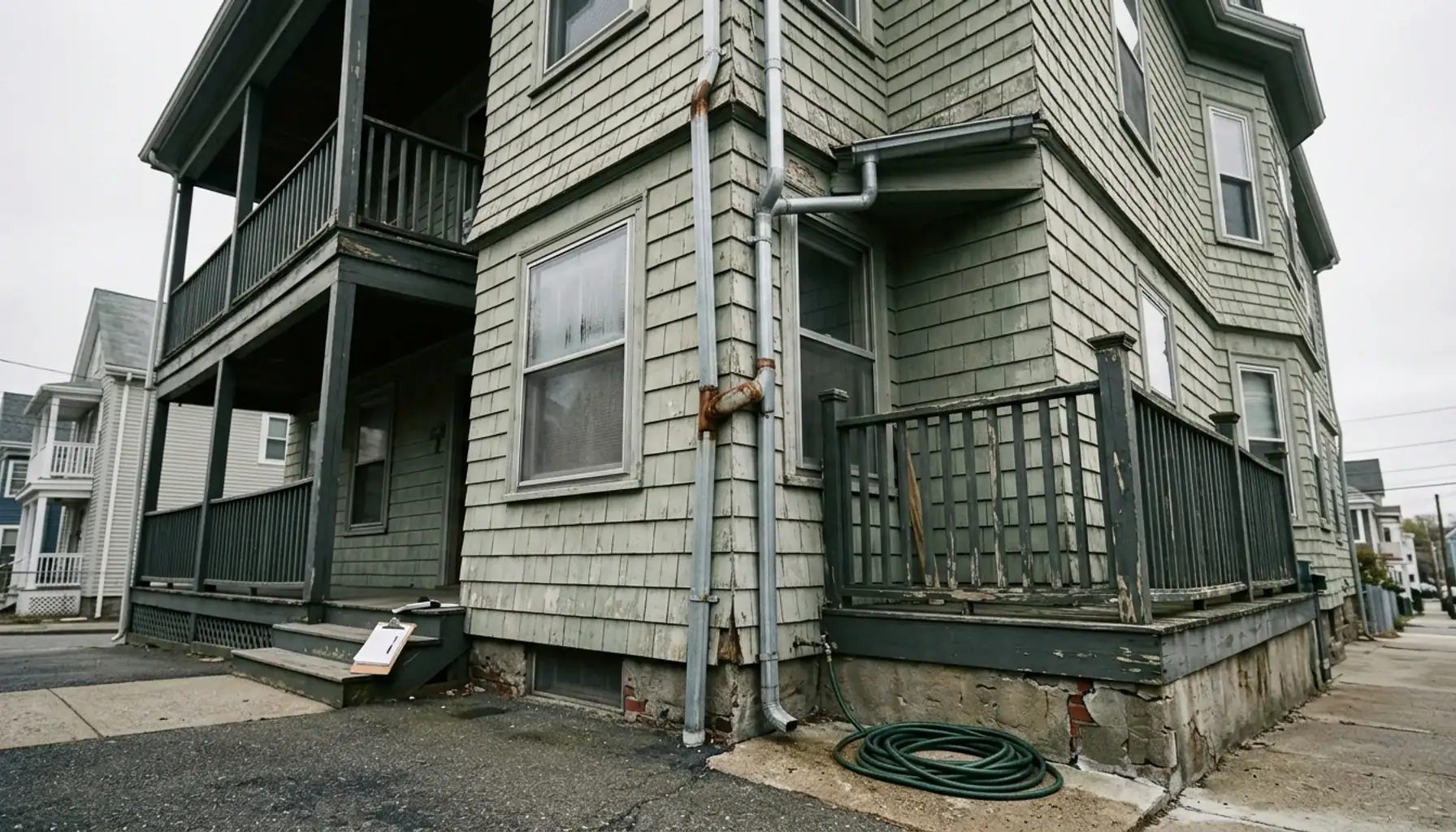
The most common home insurance inspection failures are roofs older than 20 to 25 years or showing missing shingles, knob and tube or aluminum wiring, foundation cracks, broken or missing smoke detectors, and rotted deck stairs without railings. In Massachusetts, insurers also flag aging oil tanks and unpermitted electrical work, which are common in triple-decker housing stock.
What Will Fail a Home Insurance Inspection in Massachusetts
If you own or are about to buy a triple-decker in Roxbury, a two-family in Dorchester, or a single-family in Roslindale, an insurance inspection is not the same paperwork exercise it was five years ago. Carriers are underwriting older Boston housing stock more carefully in 2026, and a failed inspection can mean a canceled binder days before closing. For how old wiring specifically can derail financing, see why knob and tube wiring can stop your Boston home sale. For a broader pre-listing repair checklist, see what to fix before selling your Boston home.
The Biggest Red Flag: Roof Condition
The biggest red flag in a home insurance inspection is an aging or damaged roof, specifically one older than 20 to 25 years or showing missing shingles, curling, or active leaks. Insurers treat roof condition as the primary driver of claim risk because water intrusion causes the most expensive and frequent property damage claims. In a Jamaica Plain triple-decker with an original asphalt roof pushing 25 years, age alone often triggers a decline.
Roofing red flags include multiple missing or cracked shingles, damaged or rusted flashing around chimneys and vents, rolled or non-standard roofing materials, and visible sagging in the roofline. Any one of these issues, combined with roof age past the 20-year mark, is typically enough for an insurer to require replacement before binding a policy.
Table-Stakes Failures Every Massachusetts Homeowner Should Know
These are the baseline categories nearly every insurer checks, regardless of carrier or property type. Missing any one of them is the most common reason Boston homeowners get an unpleasant surprise.
Roof: age over 20 to 25 years, missing shingles, damaged flashing; $8,000 to $18,000 full replacement. Electrical: knob and tube or aluminum wiring, exposed wires; $4,000 to $15,000+ depending on scope. Plumbing: galvanized steel or polybutylene pipes, active leaks; $2,000 to $10,000. Foundation: wide cracks, uneven floors, water intrusion; $3,000 to $20,000+. Safety features: missing smoke detectors, no deck railings; $100 to $1,000. Yard hazards: overhanging trees, gutter debris, poor drainage; $150 to $1,500.
Boston’s Older Housing Stock: Regional Failure Points
Boston’s building stock and climate create failure points that generic national checklists don’t cover. Underground and above-ground oil tanks are a recurring issue in single-family homes in Roslindale and Hyde Park built before natural gas conversion became standard. Many carriers decline coverage outright for properties with underground oil tanks over a certain age, or require a tank sweep and removal before binding a policy.
UFFI insulation (urea-formaldehyde foam), common in homes retrofitted during the 1970s energy crisis, is a specific red flag some Massachusetts insurers still ask about directly on applications. New England’s freeze-thaw cycles and heavy snow loads also accelerate roof and foundation wear faster than in warmer states, which is why Boston-area insurers apply roof age thresholds more strictly.
How Massachusetts Regulation Affects What Will Fail an Inspection
Massachusetts’ 760 CMR 74.00 regulation, effective October 2025, prohibits sellers from conditioning an accepted purchase offer on a buyer waiving their right to a home inspection in most residential transactions. This directly increased the number of inspections conducted across Greater Boston. Buyers waiving inspections fell to 12% in 2026, down from 18% the prior year. Before this rule, a competitive listing might see multiple buyers waive inspection contingencies, meaning defects went undiscovered until an insurance carrier’s inspector found them, sometimes after closing.
What Happens If You Fail a Home Insurance Inspection?
Failing a home insurance inspection typically triggers one of three outcomes: a required repair within a set window (most carriers give 10 to 30 days), a coverage exclusion for the specific hazard, or outright policy decline or nonrenewal. If a carrier finds knob-and-tube wiring, the carrier may issue a coverage exclusion for electrical fire damage rather than declining the entire policy, which leaves the homeowner technically insured but exposed to the exact risk that matters most. In the most serious cases where multiple hazards stack, an insurer may decline to write the policy at all.
Pre-Inspection Checklist for Boston Homeowners
- Test every smoke and carbon monoxide detector and confirm one exists in every bedroom and hallway. Replace batteries and any unit older than 10 years.
- Get your roof’s age and condition documented by a licensed roofer if it’s approaching 20 years.
- Confirm your wiring type. If knob-and-tube wiring is suspected, have a licensed electrician inspect the panel and document findings in writing.
- Inspect decks and exterior stairs for soft wood, missing railings, and loose steps. Repair or replace before the inspector arrives.
- Clear gutters and trim overhanging tree branches at least 3 to 6 feet from the roofline.
- Check your basement and attic for moisture or mold, and address any active leaks before scheduling.
- Confirm plumbing material. Galvanized steel and polybutylene pipes are known failure points; document any prior replacement with permits.
- Review foundation walls for cracks wider than a hairline, and consult a structural engineer if there is visible active movement.
- If the property has an oil tank, buried or above-ground, confirm its age and condition, since many Massachusetts carriers require documentation or removal.
Frequently Asked Questions
Can I refuse a home insurance inspection?
You can decline a scheduled inspection, but most carriers will then decline to bind or renew your policy, since the inspection is how they verify the risk they’re insuring. Refusing an inspection rarely helps and typically delays an inevitable coverage decision.
How often do insurance companies inspect homes?
Most insurers inspect a home at the point of a new policy application, then periodically thereafter, often every 3 to 5 years or whenever a claim is filed. Older homes and properties with prior claims tend to see more frequent inspection cycles.
What fixes are mandatory after a home inspection, and which are optional?
Mandatory fixes are typically life-safety and structural issues: missing smoke detectors, active roof leaks, exposed wiring, and foundation cracks that affect stability. Cosmetic issues like worn paint or outdated fixtures are rarely mandatory for insurance purposes, though they may still matter to a buyer’s inspection.
How long does a home insurance inspection take?
A standard home insurance inspection takes 30 to 60 minutes for a typical single-family home in Massachusetts. A Boston triple-decker or multi-family property can take 60 to 90 minutes, since the inspector must evaluate each unit’s wiring, smoke detectors, and safety features separately.
Do I have to disclose knob-and-tube wiring when selling my Boston home?
Yes, in practice. Massachusetts does not have a single blanket disclosure statute covering every known defect, but a seller who is asked directly about wiring type should answer honestly, since misrepresenting a known material fact can create legal exposure. More importantly, this wiring detail will almost certainly surface during the buyer’s inspection process regardless of whether it’s disclosed upfront.
Can homeowners dispute a failed insurance inspection?
Yes. Homeowners can dispute a failed insurance inspection by requesting a reinspection, providing a licensed contractor’s counter-assessment challenging the inspector’s finding, or asking the carrier’s underwriting department to clarify which specific finding triggered the decline. Documentation paired with a direct conversation with the agent resolves most disputes faster than pursuing a formal appeal process.
Have questions? Let’s connect.
About Juan Murray
Juan Murray is a Boston broker associate with more than 30 years of experience helping buyers, sellers, and investors across Greater Boston, personally leading every transaction from the first conversation through closing.
RE/MAX Real Estate Center · (617) 721-0961
Equal Housing Opportunity. Juan Murray is licensed as a Broker in Massachusetts, regulated by the Massachusetts Board of Registration of Real Estate Brokers and Salespersons. This article is general information only and does not constitute legal, tax, or financial advice. Confirm your specific costs and obligations with your closing agent, tax advisor, or lender.