A 1031 exchange lets you defer federal and Massachusetts capital gains tax when you sell an investment or rental property, as long as you reinvest the proceeds into another qualifying property. You get 45 days after closing to identify a replacement property and 180 days total to close on it, with no extensions for any reason. Triple-deckers, two-families, and other rental real estate across Dorchester, Jamaica Plain, Roslindale, Hyde Park, and Roxbury qualify as long as the property was held for investment or business use rather than as your primary residence.
1031 Exchange for Boston Investment Property Sellers
If you’re evaluating a 1031 exchange, understanding the Massachusetts capital gains picture first is essential. See capital gains tax when selling a Massachusetts investment property for the full state tax context. And if you’re weighing a straight sale vs. an exchange on a multi-family, see selling a two-family or three-family home in Boston for how each path plays out.
What Qualifies for a 1031 Exchange in Massachusetts
The rule is simpler than most sellers expect: both the property you are selling and the property you are buying need to be held for investment, rental income, or business use. They do not need to be similar in type. A triple-decker in Dorchester can exchange into a single-family rental in Roslindale, a small commercial building, or even a share in a larger investment property, as long as both sides of the transaction are investment real estate rather than a personal residence.
Your own home does not qualify, even if you rent out a unit or two in a multi-family you also live in. Only the investment portion of an owner-occupied multi-family can be exchanged. That split gets complicated fast, so this is a conversation to have with a tax professional and a qualified intermediary before you list, not after.
The Two Deadlines That Make or Break Your Exchange
45 days to identify. From the day your Boston property closes, you have 45 calendar days to formally identify potential replacement properties in writing to your qualified intermediary. This is not 45 business days. Weekends and holidays count. If your closing lands during a slow stretch for finding replacement inventory, that clock is running regardless.
180 days to close. You then have 180 calendar days from your original closing to close on the replacement property. Both deadlines run concurrently from the same starting point, which means a slow 45-day search leaves you with less runway to actually close the second deal.
A qualified intermediary holds the funds. You cannot touch the sale proceeds yourself at any point. A qualified intermediary — a neutral third party unrelated to you or your attorney — holds the funds between the sale and the purchase. Setting this up needs to happen before your original property closes, not after, since proceeds that pass through your hands even briefly can disqualify the entire exchange.
What This Means for a Dorchester or Jamaica Plain Triple-Decker Sale
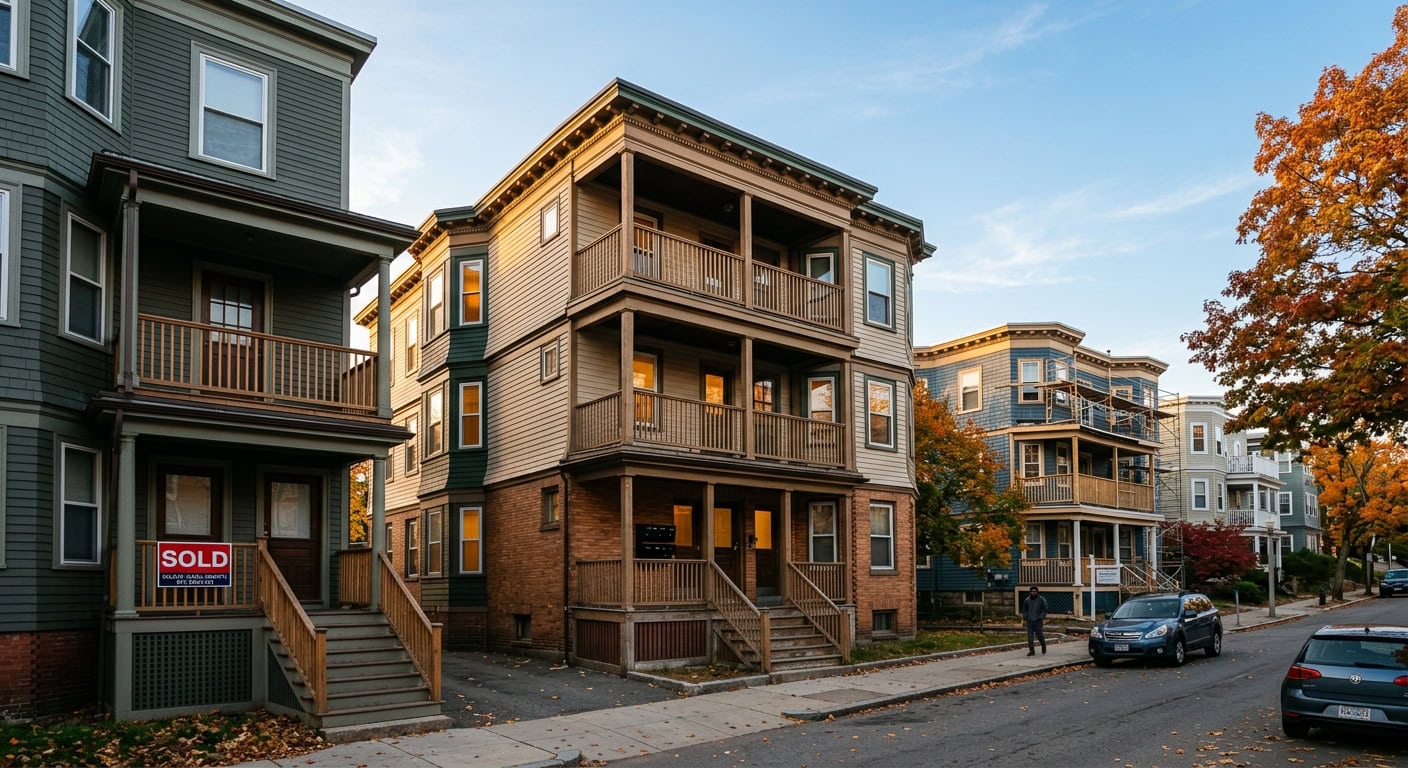
Boston’s triple-decker stock is exactly the kind of property that makes 1031 exchanges worth the paperwork. A three-family in Dorchester or Roxbury generating steady rental income often carries real embedded equity after years of appreciation, and a straight sale without an exchange means paying capital gains tax on that gain before you can redeploy the money.
A properly structured 1031 exchange can defer a meaningful chunk of combined federal and Massachusetts tax liability, often in the range of $100,000 to $130,000 on a well-appreciated Boston multi-family. Your specific number depends on your basis, your gain, and your Massachusetts tax bracket. That is a number worth running with your accountant before you decide whether to sell outright or exchange.
If your rental property currently has tenants in place, the exchange timeline adds another layer of coordination. You will need to manage tenant notice requirements and showings on the property you are selling while simultaneously searching for and underwriting a replacement property within that 45-day window.
Frequently Asked Questions
Can I do a 1031 exchange on a triple-decker I live in and also rent out?
Only the rental portion qualifies, and splitting an owner-occupied multi-family into an exchangeable investment share and a non-exchangeable personal residence share is complicated. This requires guidance from a tax professional experienced in mixed-use exchanges before you list, not a general rule of thumb applied after the fact.
What happens if I cannot find a replacement property within 45 days?
If you do not identify a qualifying replacement property in writing within 45 calendar days of your original closing, the exchange fails, and you owe capital gains tax on the sale as if no exchange had occurred. There are no extensions for any reason, which is why having realistic replacement candidates lined up before you close is critical.
Do I need a lawyer or just a qualified intermediary for a 1031 exchange in Massachusetts?
You need both. Your Massachusetts real estate attorney handles the closing itself, including the deed and title work, while a separate qualified intermediary holds your sale proceeds and manages the exchange mechanics. The two roles are distinct, and the qualified intermediary must be set up before your original property closes.
Does a 1031 exchange defer Massachusetts state tax as well as federal tax?
Yes. Massachusetts generally follows federal treatment of 1031 exchanges, so a properly structured exchange defers both your federal and Massachusetts capital gains tax liability on the sale, not just the federal portion.
Is a 1031 exchange worth it for a smaller two-family investment property?
It can be, and property size alone does not determine whether an exchange makes sense. What matters more is your embedded gain relative to the transaction costs of setting up the exchange. A qualified intermediary fee and the added complexity are worth weighing against your actual gain, which is a conversation worth having with your accountant before you decide to list.
Have questions? Let’s connect.
About Juan Murray
Juan Murray is a Boston broker associate with more than 30 years of experience helping buyers, sellers, and investors across Greater Boston, personally leading every transaction from the first conversation through closing.
RE/MAX Real Estate Center · (617) 721-0961
Equal Housing Opportunity. Juan Murray is licensed as a Broker in Massachusetts, regulated by the Massachusetts Board of Registration of Real Estate Brokers and Salespersons. This article is general information only and does not constitute legal, tax, or financial advice. Confirm your specific costs and obligations with your closing agent, tax advisor, or lender.