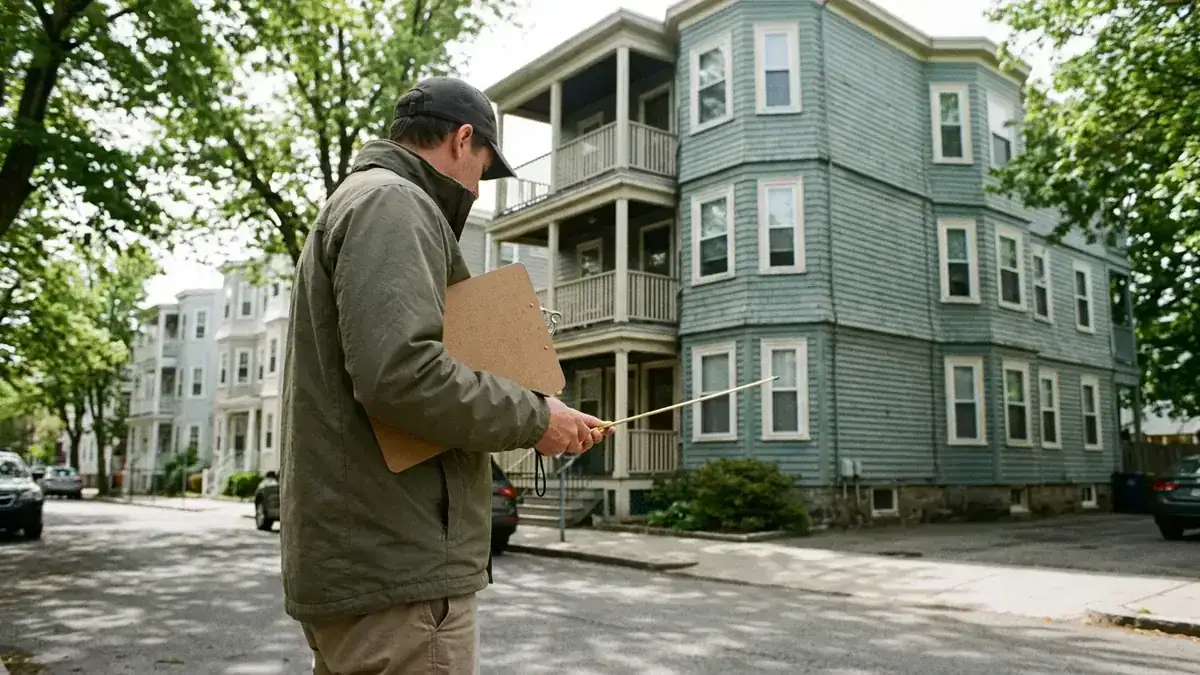
In the home appraisal vs home inspection debate, the confusion isn’t really about definitions; it’s about consequences: an appraisal tells your lender what a property is worth, while an inspection tells you, the buyer, what condition it’s actually in. Mixing up a home appraisal with a home inspection is one of the most common mistakes we see among first-time buyers in Jamaica Plain, Roslindale, Hyde Park, Dorchester, and Roxbury, and it can cost you thousands if you skip either. In Massachusetts, the distinction between a home appraisal and a home inspection matters even more since 760 CMR 74.00 took effect in October 2026.
-
In the home appraisal vs. home inspection comparison, an appraisal determines the market value for your lender; an inspection determines the physical condition for you, the buyer.
-
Boston-area inspections average around $411 in 2025-2026, above the national average of about $343, while appraisals nationally run roughly $314 to $423.
-
Massachusetts’ 760 CMR 74.00 rule, effective October 2026, prohibits sellers from conditioning an accepted offer on a waived inspection in most Greater Boston transactions.
-
Inspection waivers in Greater Boston have dropped to about 12% in 2026 (from 18% the year before), and appraisal waivers have fallen to roughly 15%.
-
The buyer typically orders and pays for the inspection soon after an offer is accepted; the lender orders the appraisal, though the buyer usually pays that fee too.
-
A low appraisal and a rough inspection report call for two completely different negotiation strategies, and mixing them up weakens your position at the table.
If you’re shopping for a triple-decker in Jamaica Plain or a condo conversion in Roslindale, you’ll run into both processes within days of getting your offer accepted. They sound similar. They are not the same thing, and mixing up a home appraisal with a home inspection during a Boston closing timeline can cost you leverage, money, or both.
This guide breaks down what each process actually checks, what it costs in the Boston market as of 2026, and how home appraisals and home inspections interact with financing, negotiation, and Massachusetts’ newer inspection rules. I’ll also cover what happens when an appraisal comes in low or an inspection turns up a problem, because that’s usually where buyers get stuck.
At Juan Real Estate Group, I walk buyers through both the appraisal and the inspection on nearly every deal across these five neighborhoods, and the pattern I see most often is buyers who assume a clean inspection means a clean appraisal, or vice versa. It doesn’t work that way, and understanding why is the first step toward protecting your offer.
What Is the Difference Between a Home Appraisal and a Home Inspection?
A home appraisal is a licensed, independent professional’s estimate of a property’s market value, ordered by your mortgage lender to confirm the home is worth at least the loan amount. A home inspection is a top-to-bottom physical examination of the property’s systems and structure, typically conducted by the buyer to identify defects before closing. In the home appraisal vs home inspection comparison, the appraisal answers “what is this worth,” and the inspection answers “what’s wrong with it.”
The two reports serve different audiences. The appraisal report goes to your lender and protects their investment. The inspection report goes to you and protects your decision to buy. As a result, one report is rarely shared with the other party, and neither should directly determine the other’s outcome. For example, a triple-decker on Amory Street in Jamaica Plain could appraise well above the asking price while still failing inspection on knob-and-tube wiring in one unit.
Both processes matter in a Massachusetts purchase, and each is addressed in a standard Massachusetts purchase and sale agreement as a separate contingency. Confusing them or assuming that a passed appraisal implies a healthy home is the single most common misconception I correct for Boston buyers.
Appraisal vs Inspection: Side-by-Side Comparison
The clearest way to understand the difference between a home appraisal and a home inspection is to compare their purposes, costs, timing, and who orders each. Boston buyers frequently ask me for a one-page reference, so here it is.
Home AppraisalHome InspectionPrimary purposeConfirms market value for the lenderAssesses physical condition for the buyerWho orders itThe mortgage lenderThe buyer, usually through their agentWho typically paysBuyer, via a fee at or before closingBuyer, paid directly to the inspectorRequired or optionalRequired on nearly all financed purchasesOptional, but strongly recommendedTypical cost (2025 to 2026)Roughly $314 to $423, national averageRoughly $350 to $650 for a single family home, Greater Boston averageTypical durationShorter walk-through, often under an hourTwo to three hours for a full propertyWhat it examinesComparable sales, condition, location, square footageRoof, foundation, plumbing, electrical, HVAC, structureEffect if unfavorableAppraisal gap; buyer covers the difference or renegotiatesRepair credits, price reduction, or contingency exit
Notice that only one of these processes is mandatory. Lenders will not fund a mortgage without an appraisal, but Massachusetts law does not require an inspection; it simply protects your right to get one.
What Comes First: Inspection or Appraisal?
The home inspection typically happens first, usually within three to ten days of an accepted offer, while the lender-ordered appraisal follows once your mortgage application is underway. This sequence exists because the inspection contingency deadline in most Massachusetts purchase-and-sale agreements is early, giving you a chance to renegotiate or walk away before you’re financially committed to the loan process.
In practice, your buyer’s agent schedules the inspector directly, often the same week you go under agreement. The appraisal comes later because the lender needs your signed purchase and sale agreement and a loan file before ordering it. As a result, you’ll usually know about condition issues weeks before you know whether the home appraises for the value.
Some cash buyers skip the appraisal step entirely since no lender is involved, but skipping the inspection is a different decision with different risks. Even in Boston’s all-cash segment, which held at roughly 27% of Greater Boston sales in 2026, I still recommend an inspection. Condition problems don’t disappear because you paid cash.
Home Inspection Costs and What You Pay For
A home inspection cost in Massachusetts covers a licensed inspector’s fee to examine the roof, foundation, electrical, plumbing, HVAC, windows, and structural components of a property, typically over two to three hours. In Boston specifically, you can expect to pay around $411 on average as of 2025-2026, notably higher than the national average of roughly $343, according to regional inspection cost data.
That premium reflects Boston’s older housing stock. Triple-deckers built between 1900 and 1920 often have legacy systems, including knob-and-tube wiring, that require additional time from inspectors to document properly. Larger multi-family properties, such as the two- and three-family homes common in Dorchester and Roxbury, also cost more to inspect because each unit requires separate attention.
Add-on inspections push the total higher. Radon testing, sewer scope inspections for older triple-deckers, and mold assessments typically add $100 to $300 each, depending on the vendor. For a full breakdown of how wiring issues specifically affect Boston transactions, see my guide on old wiring and home sales in Boston. Nationally, some 2026 industry projections put average inspection costs at $600 to $700 in the coming years due to labor and demand pressures, so locking in your inspector early in a competitive season is worth doing.
Home Appraisal Costs: Typical Price Ranges by Home Size
A home appraisal fee is a flat charge, usually paid at closing, that covers a licensed appraiser’s site visit and analysis of comparable sales to determine market value. Nationally, appraisals in 2026 average around $357, with a typical range of $314 to $423 depending on property size, complexity, and location.
For a roughly 2,000 square foot house, expect to land near the middle of that range, though Boston’s multi-family stock changes the math. Appraising a triple-decker with three separate leases takes longer than appraising a single-family home, since the appraiser must account for rental income potential alongside comparable sales. Condos in Jamaica Plain or Hyde Park typically appraise faster since condo comps are usually more plentiful and consistent.
The national appraisal industry generated an estimated $10.3 billion in revenue in 2026, a modest 2.8% gain after several years of decline, reflecting a market that’s stabilizing rather than booming. If you’re weighing whether your pricing strategy lines up with likely appraisal outcomes, my breakdown on what happens after a low appraisal in Boston covers the seller side of this same coin.
Common Red Flags That Fail Home Appraisals
A failed or low home appraisal typically results from insufficient comparable sales, visible property defects, or a purchase price that outpaced recent neighborhood activity. Appraisers don’t fail a home outright the way an inspector flags a defect; instead, they value it below the agreed purchase price, which creates a financing gap for the buyer to solve.
Specifically, the most common causes I see across Jamaica Plain and Roslindale deals include: outdated kitchens or bathrooms relative to nearby comps, unpermitted additions or unit conversions that can’t be counted toward square footage, visible deferred maintenance like a sagging roofline or peeling exterior paint, and a scarcity of recent comparable sales in tightly held pockets of Dorchester or Roxbury. Unpermitted units are a particularly common issue in Boston’s multi-family stock; my guide on unpermitted units and Boston multi-family sales covers this in more depth.
Aggressive aspirational pricing is another factor. When a seller prices well above the last three to six months of neighborhood sales, the appraisal frequently comes in below the contract price, especially in slower-absorption pockets. This is exactly why I build a seller pricing strategy around real MLS comps rather than list-price momentum alone.
Major Issues That Fail Home Inspections
The biggest red flags in a home inspection are safety and structural issues that threaten habitability or carry high repair costs, not cosmetic wear. Inspectors don’t technically “pass” or “fail” a home, but certain findings are serious enough to reshape or end a deal entirely.
In Boston’s older housing stock, the most common serious findings include: active knob and tube wiring still in use (a major insurance and safety concern in pre-1950s triple-deckers), foundation cracks or water intrusion in basement units, roof systems near or past their expected lifespan, undersized or outdated electrical panels that can’t support modern loads, and evidence of past or active mold from moisture issues common in older multi-family conversions.
Industry data suggests inspection reports commonly identify repair estimates ranging from $5,000 to $15,000 across inspected properties. That’s a wide range, and where your property lands depends heavily on age and maintenance history. A well-maintained Roslindale single-family will land on the low end; a neglected Roxbury triple-decker with original systems intact could land well above it.
How to Prepare for a Home Inspection
Preparing for a home inspection means giving the inspector full access to every system and space in the property, as restricted access can lead to incomplete reports and follow-up visits. As a buyer, your preparation is mostly logistical: confirm the inspector can access the attic, basement, electrical panel, and every unit if you’re buying a multi-family.
Steps I recommend to every buyer client:
-
Attend the inspection in person, or at a minimum, join the final walkthrough summary; seeing issues firsthand beats reading them cold in a PDF.
-
Bring a notepad and ask the inspector to rank findings by urgency, not just list them alphabetically.
-
Request access to all units in advance when buying a two- or three-family, since tenants’ schedules can delay full access for inspection.
-
Budget for specialty add-ons upfront (sewer scope, radon, mold) rather than deciding mid-inspection, since scheduling a second visit adds days to your timeline.
-
Review your inspection contingency deadline in the purchase and sale agreement before the inspection date, not after.
As of October 2026, Massachusetts regulation 760 CMR 74.00 prohibits sellers from conditioning an accepted offer on a waived inspection in most residential transactions, with narrow exemptions for auctions, foreclosures, certain family transfers, and pre-completion new construction with qualifying warranties. That’s a meaningful shift from the waiver-heavy bidding wars of prior years, and one reason waived inspections in Greater Boston fell to roughly 12% in 2026.
How to Prepare for a Home Appraisal
Preparing for a home appraisal means presenting the property in its best objective condition and supplying the appraiser with documentation that supports value, since appraisers rely heavily on visible condition and verifiable upgrades. Unlike inspection prep, appraisal prep is about value support, not access logistics.
Practical steps that help: complete minor repairs before the appraisal date (a loose railing or peeling paint can subtly lower a condition rating), provide a list of recent capital improvements with dates and costs (new roof, updated electrical panel, renovated kitchen), and share a comparable sales list your agent has pulled if the appraiser is unfamiliar with a specific pocket of Hyde Park or Dorchester. Appraisers welcome this information; it’s not considered pressure; it’s data.
For FHA-financed purchases specifically, the appraisal must also confirm that the property meets HUD’s minimum property standards under HUD Handbook 4000.1, which directly tie certain safety and structural conditions to appraisal acceptance. That means an FHA appraisal can flag issues an inspector would also catch, like exposed wiring or a non-functional heating system, blurring the line between home appraisal and home inspection more than buyers expect.
Negotiation Strategies After Inspection Results
Negotiating after a home inspection means using the report’s specific findings, not general dissatisfaction, to request repairs, a price reduction, or a closing credit. Sellers and their agents respond far better to itemized, cost-backed requests than to broad statements like “the house needs work.”
Effective approaches I use with buyer clients: request a credit at closing rather than asking the seller to complete repairs themselves, since seller-completed repairs are often done at the lowest possible cost. Prioritize your ask list; leading with a $12,000 electrical rewrite request buries the $200 fix on a leaking faucet. And get contractor estimates before you negotiate, since a vague “$5,000 to $15,000” range from the inspector won’t hold up against a seller’s counter unless you’ve narrowed it down.
In a market where inspection waivers have fallen to around 12% in 2026, sellers increasingly expect inspection-based negotiation as a normal part of the process, not an aggressive move. That’s a real shift from the seller’s-market dynamics of a few years ago, and it favors buyers willing to negotiate methodically rather than emotionally.
What to Do If Appraisal Comes in Low
When a home appraisal comes in below the agreed purchase price, the buyer generally has three options: pay the difference in cash, renegotiate the price with the seller, or challenge the appraisal with additional comparable sales data. Lenders will only finance up to the appraised value, so the gap between the contract price and the appraised value becomes the buyer’s problem to solve unless the seller agrees to close it.
First, ask your agent to request an appraisal rebuttal with stronger, more recent comps if you believe the appraiser missed relevant sales, which is particularly common in thinly traded pockets of Roxbury or Dorchester where fewer transactions occur. Second, negotiate with the seller to split or absorb the gap, especially if your purchase and sale agreement includes an appraisal contingency. Third, if neither works, you’ll need to bring additional cash to closing to bridge the difference or walk away under contingency terms.
Appraisal gaps are more common when buyers waive appraisal contingencies to win competitive multiple-offer situations. With appraisal waivers down to roughly 15% in Greater Boston in 2026, fewer buyers are taking on this risk than in prior years, a trend worth understanding before you decide whether to waive one yourself.
Timeline: From Offer to Appraisal to Closing
The Massachusetts homebuying timeline from accepted offer to closing typically runs 30 to 60 days, with the inspection occurring first and the appraisal following once your mortgage application is fully underway. Understanding this order helps you plan around each contingency deadline without letting one process delay the other.
A typical sequence looks like this: offer accepted and purchase and sale agreement signed within one to two weeks, inspection completed within three to ten days of going under agreement, mortgage application finalized and appraisal ordered soon after, appraisal completed two to three weeks before closing, and final walkthrough and closing scheduled once financing is fully approved. For a full breakdown of what happens between offer acceptance and the closing table, see my guide on what happens after you accept an offer in Massachusetts.
Delays typically come from one of two places: an inspection turning up an issue that requires re-negotiation before you’ll sign off on financing, or an appraisal coming in low and requiring a second round of lender review. Building a few extra days of cushion into your closing date accounts for either scenario.
State-by-State Differences in Inspection and Appraisal Requirements
Inspection and appraisal requirements vary by state, and Massachusetts stands out in 2026 for its explicit protection of buyer inspection rights under 760 CMR 74.00. Not every state has a comparable rule preventing sellers from pressuring buyers to waive inspections as a condition of an accepted offer.
In practice, this means you, as a Boston buyer, now have a stronger legal footing to insist on an inspection than buyers in states without similar regulation, even in competitive multiple-offer situations. Appraisal requirements, by contrast, are largely consistent nationwide, as federal lending standards set by agencies overseeing conventional, FHA, and VA loans drive them rather than state law. VA appraisals, for instance, follow their own minimum property requirements regardless of the state where the property is located, similar in spirit to the FHA standards mentioned earlier.
If you’re relocating to Boston from a state with looser inspection norms, this is worth flagging early with your agent. Out-of-state investors in particular sometimes assume inspection waivers are still standard practice here; as of October 2026, that assumption no longer holds in most residential transactions.
Practical Guidance: How to Prioritize Appraisal and Inspection in Your Offer Strategy
Choosing how to handle appraisal and inspection contingencies in your offer strategy comes down to balancing competitiveness against risk exposure, and Boston’s 2026 market gives you more room to keep both protections than the market did a year or two ago. With first-time buyers now representing roughly 31% of Greater Boston transactions, this decision affects a large share of the current buyer pool.
Common mistakes I see buyers make:
-
Waiving the inspection to strengthen an offer, then discovering major system issues after closing with no recourse.
-
Assuming a strong appraisal means the home has no condition issues, then skipping the inspection entirely is justified.
-
Negotiating repair credits without contractor estimates weakens their position against a seller’s counter.
-
Ignoring the inspection contingency deadline in the purchase and sale agreement forfeits their right to renegotiate.
-
Assuming an appraisal contingency and an inspection contingency work the same way, they trigger under completely different conditions.
The trade-off is straightforward: waiving contingencies can make an offer more attractive to a seller, but it shifts financial and condition risk entirely onto you. My advice: in a market where waivers have already declined to the 12 to 15% range in 2026, you’re not competing against as many waived offers as buyers were a year or two ago, so keeping your protections is the smarter play for most buyers right now.
Suppose you’re weighing how to structure an offer around these contingencies, especially as a first-time buyer navigating a Jamaica Plain condo or a Dorchester multi-family. A first-time homebuyer program in Massachusetts may also affect your appraisal requirements depending on the loan type. This is exactly the kind of decision where a second set of eyes from a broker who works these five neighborhoods daily is worth more than guesswork.
Frequently Asked Questions
What comes first, appraisal or home inspection?
The home inspection typically comes first, usually within three to ten days of an accepted offer, since inspection contingency deadlines fall early in a Massachusetts purchase and sale agreement. The lender-ordered appraisal follows once your mortgage application is underway, generally two to three weeks before closing.
What is the biggest red flag in a home inspection?
The biggest red flags are safety and structural issues, including active knob-and-tube wiring, foundation cracks with water intrusion, an undersized electrical panel, or a roof near the end of its lifespan. These findings carry the highest repair costs and the most negotiating leverage.
How much is an appraisal for a 2000 sq ft house?
A home appraisal for a roughly 2,000 square foot house typically falls within the national range of $314 to $423 as of 2026, averaging around $357. Multi-family properties or homes with complex layouts, common in Boston’s triple-decker stock, often run toward the higher end of that range.
What will fail a home appraisal?
An appraisal doesn’t technically “fail,” but it can come in below the purchase price due to a lack of comparable sales, visible deferred maintenance, unpermitted additions that can’t count toward square footage, or a contract price that outpaced recent neighborhood activity.
Who pays for the inspection when buying a house?
The buyer pays for the home inspection directly, typically at the time of service, since the buyer orders it to protect their purchase decision. This differs from the appraisal fee, which the buyer also usually pays but which the lender orders.
Can you negotiate after a home inspection?
Yes, buyers routinely negotiate after a home inspection by requesting repair credits, a price reduction, or specific repairs, using itemized findings and contractor estimates rather than general complaints. This is one of the most common ways Boston buyers recover leverage after a competitive offer process.
What happens if the appraisal comes in low?
If the appraisal comes in below the contract price, the buyer can pay the difference in cash, renegotiate the price with the seller, or challenge the appraisal with stronger comparable sales data. Lenders will only finance up to the appraised value, so the gap must be resolved before closing.
Conclusion: Appraisal vs Inspection, Two Different Jobs
The core distinction between a home appraisal and a home inspection comes down to this: an appraisal protects your lender’s investment by confirming value, while an inspection protects you by confirming condition. Boston buyers in 2026 are navigating both processes in a market shaped by 760 CMR 74.00, rising inspection costs near $411 locally, and declining waiver rates across appraisal and inspection contingencies alike.
Neither process is optional to understand, even though only the appraisal is required by your lender. Skipping either one, or assuming a strong result in one predicts a strong result in the other, is how buyers end up surprised at the closing table. The safer path is to treat a home appraisal and a home inspection as separate, sequential steps in your homebuying timeline, each with its own preparation, risks, and negotiation strategy.
Whether you’re a first-time buyer weighing a Jamaica Plain condo, an investor evaluating a Roxbury triple-decker, or comparing offers on a Dorchester two-family, understanding home appraisal vs home inspection will shape your entire negotiation strategy in 2026 and beyond.
If you’re weighing an offer strategy around appraisal and inspection contingencies in Jamaica Plain, Roslindale, Hyde Park, Dorchester, or Roxbury, a free, confidential consultation with me can help you sort out the real numbers before you commit to anything. Get started with Juan Real Estate Group to build a buyer strategy grounded in real MLS data, not guesswork.
Written by Juan Murray, Broker Associate, RE/MAX Real Estate Center, with 30+ years of Boston real estate experience at Juan Real Estate Group