The things to consider in buying a house come down to five factors that actually move the needle: what you can truly afford, the property’s condition, the location’s resale strength, the total cost beyond the sticker price, and your walk-away leverage if something feels wrong. Everything else is detail work around those five.
Things to Consider When Buying a House in Boston
This guide breaks down the things to consider in buying a house into a decision framework you can actually use. It covers financial readiness, the specific red flags that should stop you cold, the frameworks buyers ask about most (the 3-3-3 rule, the four C’s), and the Massachusetts-specific rules that changed how Boston deals get done in 2026. To know what you’ll be paying at the closing table, see closing costs for Boston buyers. And before you sign with an agent, see buyer representation agreements in Massachusetts.
What Is the 3-3-3 Rule for Buying a House?
The 3-3-3 rule is a budgeting guideline that says your home purchase price should be roughly 3 times your annual gross income, your down payment plus closing costs shouldn’t exceed 3 months of savings, and your total monthly housing costs shouldn’t exceed 3 weeks’ worth (about 25%) of your monthly gross pay. It’s a sanity check, not gospel. In a market where Boston-area households spend an average of $105,320 per year, with housing, food, and transportation eating 62% of that budget, the 3x-income rule breaks down fast. A triple-decker in Dorchester or a two-family in Hyde Park can easily run 4 to 5 times a household’s income. Use the 3-3-3 rule as a starting filter, then run your actual numbers.
What Are the Four C’s of Buying a House?
The four C’s of home buying are Credit, Capacity, Capital, and Collateral — the same underwriting framework mortgage lenders use to approve your loan and set your rate. Credit is your credit score and payment history. Capacity is your debt-to-income ratio: lenders want to see this comfortably under 43%. Capital is your liquid assets: down payment, closing costs, and reserves after closing. Collateral is the property itself — specifically whether the appraisal supports the purchase price. Every one of these four factors interacts with the others, and where you’re weakest shapes your entire offer strategy.
What Are the Biggest Red Flags When Buying a House?
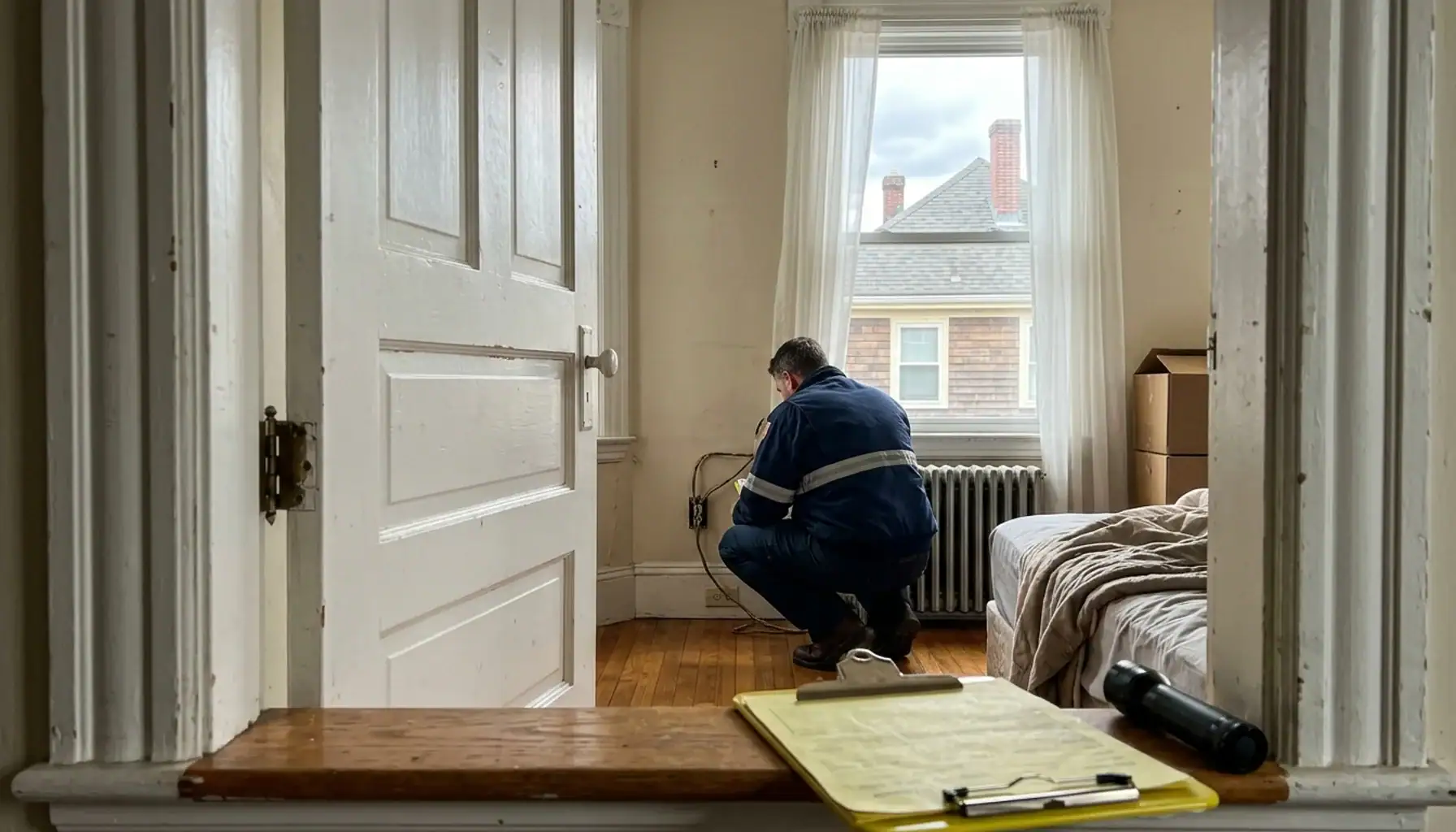
Physical red flags include foundation cracks wider than a hairline, water staining in basements or ceilings, musty odors suggesting mold or moisture intrusion, knob-and-tube wiring (common in older Boston triple-deckers and a real factor in insurability), rooflines that sag, and HVAC systems older than 15 to 20 years. None are automatic deal-killers — they’re negotiation leverage if you catch them before closing.
Paperwork red flags include unpermitted additions, unclear title history, missing certificates of occupancy for converted units, and, for multi-family properties, leases that don’t match what the seller told you verbally.
Behavioral red flags include pressure to skip the inspection, an unusually short option period, or pressure to remove contingencies before you’ve seen inspection results. As of October 2025, 760 CMR 74.00 prohibits Massachusetts sellers from conditioning an accepted offer on a waived inspection in most residential transactions. If a seller or their agent suggests otherwise in 2026, that itself is a red flag.
| Red Flag Category | Example | What to Do |
|---|---|---|
| Physical | Water stains, foundation cracks, old wiring | Get a licensed inspector to quantify repair cost before you negotiate |
| Paperwork | Unpermitted additions, mismatched leases | Request permit history and lease copies before your inspection contingency expires |
| Behavioral | Pressure to waive inspection or shorten contingency windows | Know your rights under current Massachusetts rules and involve your agent immediately |
How Much House Can You Actually Afford Beyond the Down Payment?
True home affordability includes closing costs (typically 2% to 5% of the purchase price), ongoing maintenance (about 1% of home value per year), property taxes, insurance, and a repair reserve. Closing costs on a $500,000 Boston purchase can run $10,000 to $25,000. Add annual maintenance at 1% of value, roughly $5,000 a year, and a repair reserve of another 1% to 3% for the first year specifically. For older housing stock — and Boston has plenty of it — this reserve matters more than average. A triple-decker built in the early 1900s may still have original plumbing or partial knob-and-tube wiring. The inspection report becomes your negotiating document, not just a formality.
What Should Be on Your Home Inspection Checklist?
A home inspection checklist should cover the roof, foundation, electrical panel and wiring type, plumbing supply lines, HVAC age and function, water intrusion signs in the basement or attic, window seals, and for multi-family properties, each unit’s systems separately. A standard inspection in the Boston metro averages about $411 in 2025-2026, compared with a national average near $343. For triple-deckers and two-families specifically, insist on a full inspection of every unit. Knob-and-tube wiring in Dorchester and Roxbury multi-families built before the 1950s affects insurability and can require a full rewire running into five figures — a number to know before you write an offer, not after.
Practical Guidance: How to Actually Decide
- Confirm your real number first. Get pre-approved, not pre-qualified. Lenders and sellers treat these very differently in a competitive offer.
- Rank your must-haves against your nice-to-haves separately. Location and structural condition should always outrank finishes. You can renovate a kitchen. You cannot move a foundation.
- Get the inspection, every time. With only 12% of Greater Boston buyers waiving inspections in 2026, and doing so now legally restricted in most transactions, there is little reason left to skip this step.
- Price the repairs before you negotiate. A vague “the roof looks old” is not leverage. A contractor estimate of $14,000 for a full roof replacement is leverage.
- Set your walk-away number before you fall for the house. Decide your maximum offer and your dealbreaker conditions before your first showing, not during the adrenaline of a bidding war.
- Read the absorption rate, not just the median price. A property sitting at 60-plus days in a slow-moving submarket gives you more negotiating room than a headline price suggests.
Frequently Asked Questions
What is the 3-3-3 rule for buying a house?
The 3-3-3 rule suggests your home price stay near 3 times your annual income, your down payment plus closing costs stay under 3 months of savings, and your monthly housing costs stay under roughly 25% of your monthly gross income. Treat it as a starting filter, not a hard rule, especially in higher-cost markets like Boston.
What are the four C’s of buying a house?
The four C’s are Credit, Capacity, Capital, and Collateral — the core factors mortgage lenders evaluate during underwriting. Credit covers your score and payment history, Capacity is your debt-to-income ratio, Capital is your available cash and reserves, and Collateral is the property’s appraised value relative to your offer.
What salary do you need for a $400,000 house?
Most lenders want housing costs near 28% of gross monthly income, which generally means an annual household income between $90,000 and $110,000 for a $400,000 purchase, depending on your down payment, credit score, and current interest rate. Run the exact number with a lender using your specific financial profile.
What are the biggest red flags when buying a house?
The biggest red flags include foundation and water damage signs, outdated electrical systems like knob-and-tube wiring, unpermitted work, mismatched lease documentation on multi-family properties, and any pressure from a seller to waive your inspection rights. None of these automatically kill a deal, but each one needs to be priced and negotiated before you close.
Do I have to get an inspection when buying a house in Massachusetts?
An inspection is not legally required to buy a home in Massachusetts, but as of October 2025 sellers can no longer condition an accepted offer on you waiving that right in most residential transactions under 760 CMR 74.00. Given that a Boston-area inspection averages around $411, skipping it to save money rarely makes financial sense.
Is it better to buy a condo or a multi-family property in Boston?
It depends on your goals. A condo generally means lower maintenance responsibility but a monthly fee and shared building decisions. A multi-family property offers rental income potential and more control but requires managing tenants and full building upkeep. Buyers focused on offsetting their mortgage through rental income often lean toward multi-family, while buyers prioritizing lower hands-on maintenance often prefer condos.
Have questions? Let’s connect.
About Juan Murray
Juan Murray is a Boston broker associate with more than 30 years of experience helping buyers, sellers, and investors across Greater Boston, personally leading every transaction from the first conversation through closing.
RE/MAX Real Estate Center · (617) 721-0961
Equal Housing Opportunity. Juan Murray is licensed as a Broker in Massachusetts, regulated by the Massachusetts Board of Registration of Real Estate Brokers and Salespersons. This article is general information only and does not constitute legal, tax, or financial advice. Confirm your specific costs and obligations with your closing agent, tax advisor, or lender.